Melolingua Publishing · Book Companion
Capítulo 1: El Descubrimiento de Clara
Clara arrives in Madrid to start her library job and discovers a cold, dusty archive room in the basement, where a mystery from 1954 awaits.
Pre-Reading Vocabulary
"La calle de Atocha siempre está concurrida."
"El aroma a café caliente llena la sala."
"Clara viaja a Madrid con gran esperanza."
"Su nuevo hogar es una buhardilla pequeña."
"Las viejas escaleras de madera crujen mucho."
"El archivo está en el sótano frío."
Chapter Audio Narration
Texto en Español
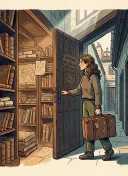
Page LeftClara camina despacio por la concurrida calle de Atocha, con su pesada maleta en la mano y el ruido de Madrid en los oídos. Las persianas metálicas de las tiendas chirrían al abrirse, mientras el aroma a churros fritos y café recién hecho escapa de los pequeños bares de la esquina. El sol de la mañana empieza a brillar con fuerza, iluminando las letras doradas de Cervantes grabadas en el suelo de adoquines del céntrico Barrio de las Letras. Madrid es un laberinto dinámico lleno de coches, gente siempre activa y balcones llenos de plantas que Clara mira con curiosidad. Clara tiene veintiséis años, trabaja de archivera y viaja a la capital con una mezcla de gran esperanza y un cansancio que le pesa en el alma. Su nuevo hogar es una buhardilla minúscula pero acogedora en la última planta de un edificio antiguo que huele a madera vieja. En el portal, la portera le entrega las llaves de metal y le da una cálida bienvenida con una sonrisa cansada. Clara sube las escaleras de madera que crujen con cada paso, deseando dejar la maleta y mirar el cielo de Madrid desde su pequeña ventana. Desde el tejado ve la cúpula de una iglesia lejana y escucha el murmullo constante de la ciudad que nunca duerme. Unas horas más tarde, va a la Biblioteca Histórica del barrio, un imponente edificio de piedra que custodia miles de vidas impresas. La directora, la señora Vargas, la recibe en su despacho con una taza de café caliente que Clara acepta agradecida. La directora, la señora Vargas, la recibe en su despacho con una taza de café caliente que Clara acepta agradecida. " El trabajo es urgente, Clara", dice la señora Vargas con tono serio. " El sótano esconde documentos sin catalogar desde la Guerra Civil." El sótano esconde documentos sin catalogar desde la Guerra Civil." Bajan por una escalera de caracol de piedra fría, donde la luz del día desaparece y el aire se vuelve denso y helado. Al final del pasillo hay una puerta de madera maciza con un viejo cartel de metal negro que dice: "Archivo Reservado". La llave gira con un quejido metálico y, al abrirse, un fuerte olor a polvo y a secretos guardados golpea a Clara. Cientos de cajas de cartón marrón llenan las estanterías de suelo a techo, cubiertas por una gruesa capa de olvido gris. " Nadie entra aquí desde hace treinta años", explica Vargas, dejando a Clara sola frente al abismo de papel. Con el corazón acelerado, Clara camina entre las estanterías oscuras y toca el lomo frío de un archivador de madera. Ella sabe que cada caja esconde fragmentos de vidas pasadas, pero el frío del sótano le produce un leve estremecimiento. De repente, ve un escritorio antiguo de roble en un rincón oscuro, cubierto por una sábana blanca llena de telarañas. Retira la sábana despacio y descubre una taza de café vacía, seca y con una mancha de tinta negra a su lado. El cajón principal del escritorio tiene una cerradura de bronce oxidada, pero está mal cerrado, dejando una rendija abierta. Clara abre el cajón con cuidado y encuentra un sobre grueso y amarillento atado con una cinta de seda roja. En el sobre de papel rugoso hay una frase escrita a mano con tinta violeta y una caligrafía temblorosa. Clara lee con asombro las palabras escritas: "Para Clara. La caja del sello de lacre rojo es peligrosa". Clara contiene la respiración, helada de miedo y fascinación: la carta está fechada en mayo de 1954, pero lleva su propio nombre. Es la fecha exacta en que su abuela desapareció de Madrid, dejando solo una maleta vacía y un silencio de setenta años.
English Translation
Clara walks slowly along the bustling Atocha Street, her heavy suitcase in hand and the roar of Madrid filling her ears. Metal shutters screech open as shopkeepers start their day, while the scent of freshly
fried churros and espresso drifts from the corner bars. The morning sun begins to break, lighting up Cervantes' golden quotes engraved directly into the cobblestones of the historic Literary Quarter. Madrid is a dynamic maze of
traffic, people constantly on the move, and balconies overflowing with ivy and geraniums that Clara watches with curiosity. Clara is twenty-six, an archivist by trade, arriving in the capital with a mixture of high hopes and
an exhaustion that weighs heavy on her soul. Her new home is a tiny but cozy attic room on the top floor of an ancient building that smells of aged timber. At the entrance, the building
manager hands her the metal keys and welcomes her warmly with a tired smile. Clara climbs the wooden stairs, which creak under her feet, eager to drop her suitcase and look out at the Madrid
sky from her small window. From the rooftops, she spots the dome of a distant church and listens to the constant hum of a city that never sleeps. A few hours later, she heads to the
neighborhood's Historical Library, an imposing stone building that guards thousands of lives preserved in print. The director, Mrs. Vargas, greets her in her office with a cup of hot coffee, which Clara accepts gratefully. " The
work is urgent, Clara," Mrs. Vargas says with a serious tone. " The basement hides documents that haven't been catalogued since the Civil War." They descend a cold stone spiral staircase, where daylight fades away and
the air turns thick and freezing. At the end of the hallway stands a solid wooden door with a weathered black metal sign reading: "Restricted Archive." The key turns with a metallic groan; as it
swings open, a strong draft of dust and long-guarded secrets hits Clara. Hundreds of brown cardboard boxes fill the shelves from floor to ceiling, covered under a thick layer of grey neglect. " No one has
set foot in here for thirty years," Vargas explains, leaving Clara alone in front of the abyss of paper. With her heart racing, Clara walks between the dark shelves and touches the cold spine of a
wooden filing cabinet. She knows that every box hides fragments of past lives, but the chill of the basement sends a slight shiver through her. Suddenly, she spots an antique oak desk in a dark corner,
covered by a white sheet full of cobwebs. She removes the sheet slowly and discovers an empty, dry coffee cup with a black ink stain beside it. The main drawer of the desk has a
rusted bronze lock, but it is slightly ajar, leaving a narrow crack open. Clara opens the drawer carefully and finds a thick, yellowed envelope tied with a red silk ribbon. On the rough paper envelope, there
is a handwritten sentence in violet ink, written in a shaky hand. Clara reads the written words in astonishment: "For Clara. The box with the red wax seal is dangerous." Clara holds her breath, frozen in
fear and fascination: the letter is dated May 1954, but it bears her own name. It is the exact date her grandmother disappeared from Madrid, leaving behind only an empty suitcase and seventy years of silence.
Answer these questions based on what you read in Spanish.
Capítulo 1 Comprehension Check
1. What does Clara discover on Atocha Street while walking to her new home?
Correct: The noise of Madrid and shutters opening with the smell of churros and coffee
The Literary Quarter awakens with the screeching sound of its metal shutters and the scent of churros and espresso.
2. How is Clara's apartment (attic room) described?
Correct: A tiny but cozy attic room that smells of old wood
Her home is a tiny but cozy attic room on the top floor.
3. From what era are the uncatalogued documents in the library basement?
Correct: From the Spanish Civil War
Mrs. Vargas tells Clara that the basement hides documents uncatalogued since the Spanish Civil War.
4. What does Clara find when she removes the sheet from the oak desk?
Correct: An empty dry coffee cup with a black ink stain next to it
Clara finds an empty, dry coffee cup with a black ink stain at its side.
5. What warning does the thick envelope addressed to 'Clara' contain?
Correct: That the red wax-sealed box is dangerous
The letter, written with a trembling hand, warns that the box with the red wax seal is dangerous.
Now make it stick.
You've read Chapter 1. Test your understanding, practice speaking it aloud, and track your progress in the Melolingua app — it saves to your bookshelf, so every chapter you read turns into real Spanish.
Note: You'll be taken to the Melolingua Web App to test yourself and practice speaking. A free account keeps your progress synced — it only takes a few seconds.