In Treno verso Firenze
At a glance
- A1 Italian
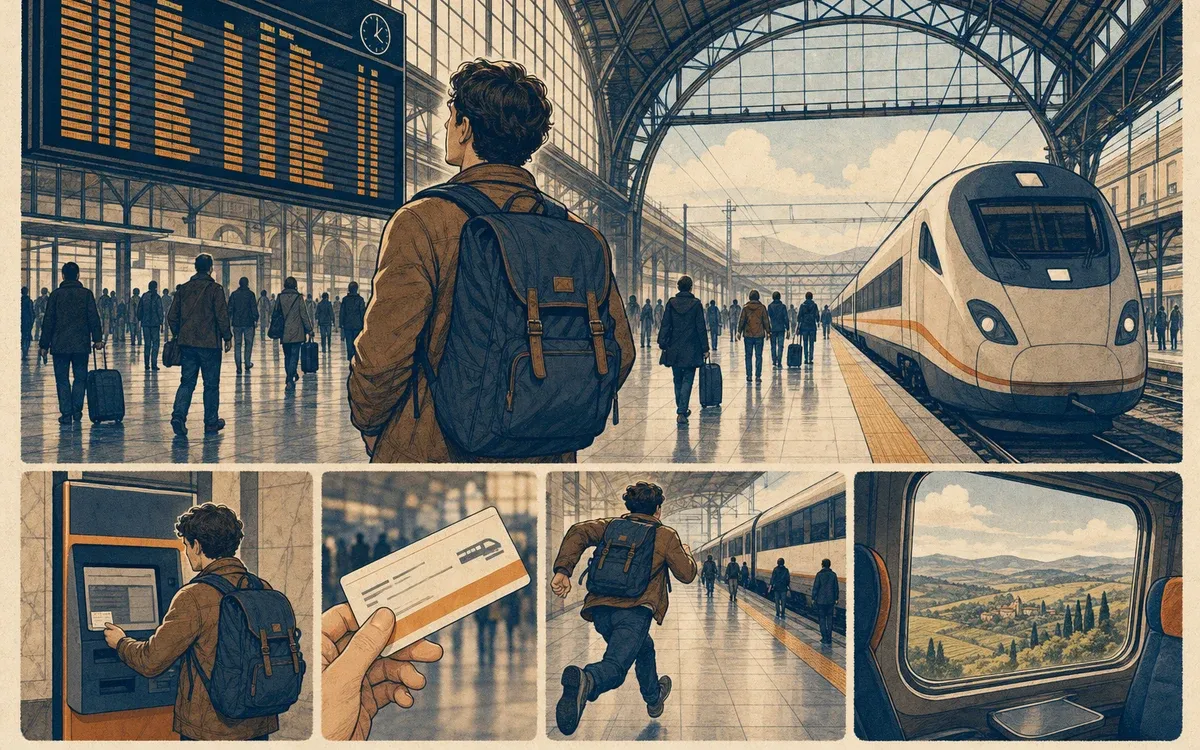
- Luca takes the train from Rome to Florence. The Roma Termini station is big and noisy. Luca looks at the departure board.…
- Practice focus
- A1 Italian reader practicing Present tense and Prepositions of place in a venice travel.
- Story value
- 20 interactive lines, Spotlight words include treno, binario, finestrino.
Read in Italian, tap highlighted words when you need help
Interactive story reader
Luca prende il da Roma a Firenze. La stazione di Roma Termini e grande e rumorosa. Luca guarda il tabellone delle partenze. Il suo treno parte dal cinque alle dieci e trenta. Compra un alla macchinetta e corre verso il binario. Sale sul treno e trova il suo posto vicino al . Il treno parte puntuale. Luca guarda fuori dal finestrino. Vede le verdi della Toscana, i campi di girasoli e i piccoli paesi. "Che bello," pensa Luca. Una signora anziana si siede accanto a lui. "Va a Firenze?" chiede lei. "Si, vado a trovare un amico," risponde Luca. "Firenze e bellissima. Deve visitare il Duomo e Ponte Vecchio," dice la signora. Dopo un'ora e mezza, il treno arriva a Firenze. Luca scende e vede il suo amico che lo aspetta. "Benvenuto a Firenze!" dice l'amico. Luca sorride. L' comincia.
Show full English translation
Luca takes the train from Rome to Florence. The Roma Termini station is big and noisy. Luca looks at the departure board. His train departs from platform five at ten thirty. He buys a ticket at the machine and runs toward the platform. He gets on the train and finds his seat next to the window. The train leaves on time. Luca looks out the window. He sees the green hills of Tuscany, the sunflower fields, and the small towns. "How beautiful," Luca thinks. An elderly lady sits next to him. "Are you going to Florence?" she asks. "Yes, I'm going to visit a friend," Luca replies. "Florence is very beautiful. You must visit the Duomo and Ponte Vecchio," says the lady. After an hour and a half, the train arrives in Florence. Luca gets off and sees his friend waiting for him. "Welcome to Florence!" says his friend. Luca smiles. The adventure begins.
Vocabulary recap
Free on the web → full practice in the app Read Italian here, then continue with native audio, speaking practice, quizzes, and flashcards in MeloLingua.
Want to hear this story read by a native speaker and practice your pronunciation with guided feedback?
That is the path from this page to your daily habit: read free on the web, then open MeloLingua for listening, speaking, and review tools built around real stories.
What you get on this page vs in the app
This page is a free graded reader. MeloLingua adds everything you need to turn input into listening and speaking practice—plus stories that adapt to you across Spanish, French, German, and Italian.
| Experience | This page | MeloLingua app |
|---|---|---|
| Audio narration | Read silently | Native speaker audio in the app |
| Speaking practice | — | Guided pronunciation feedback |
| Personalized stories | — | Stories generated for your level and interests |
| Translation | English below the Italian text | Toggle translations on or off while you read |
| Comprehension | Self-check with the glossary | Short quizzes tied to each story |
| Vocabulary | Glossary on this page | Flashcards from story context |
| Languages | This story’s language only | Spanish, French, German, Italian |
| Where to use it | Web reader | Android app; iOS waitlist |
Quick answers
- Can I hear this story read by a native speaker?
- This page is text-first for free reading. In MeloLingua, stories include native speaker narration with text you can follow along—built for listening, not just silent reading.
- How do I practice pronunciation for what I read here?
- Open the same kind of content in the app: you get speaking practice with feedback so you can align your rhythm and sounds with the narration.
- Which languages does MeloLingua cover?
- Spanish, French, German, and Italian—with level-matched libraries and personalized story options in the app.
Keep practicing
Explore this story by theme
Related Italian Stories

Al Mercato
It's Saturday morning and Giulia goes to the market at Campo de' Fiori, in Rome. The market is outdoors and there are many colorful stalls.
Open story →
Il Caffe della Mattina
Every morning, Marco wakes up at seven. He gets dressed quickly and leaves the house. He walks down the street to the bar below his home.
Open story →
Il Gelato Perfetto
It's a hot summer afternoon. Sofia walks through the streets of Florence with her friend Chiara. "I feel like having a gelato," says Sofia.
Open story →