La Panadería del Sábado
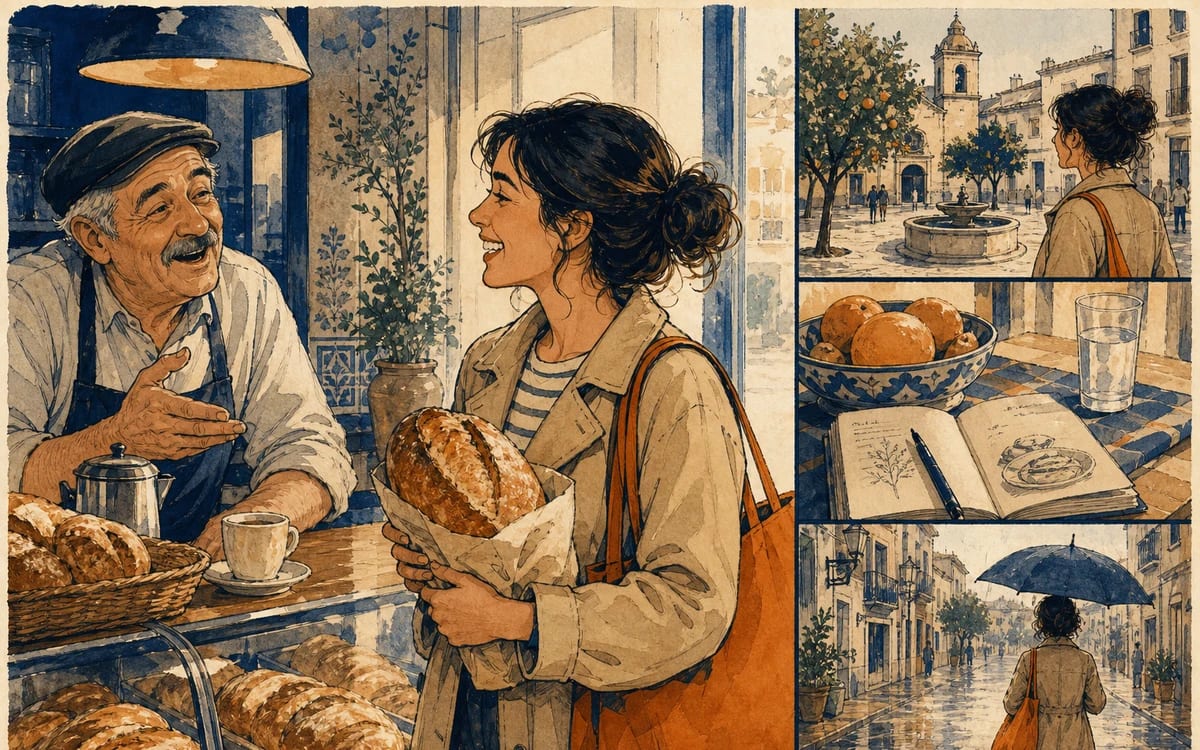
Sofía ventured out early on Saturday, eager to snag some freshly baked bread before the line snaked around the corner.
What you'll learn
- Bilingual graded story
- Native narration
- 10 useful words
- 3 comprehension questions
Then shadow
Borrow the narrator’s rhythm
Pause after this line and repeat it aloud without translating. Aim for three clean repetitions.
1Listen first
Hear the whole story
Native Spanish narration of this exact text. Keep the transcript visible on the first pass.
Playback speed: Natural
2Then shadow
Sofía salió temprano el sábado porque quería comprar pan recién horneado antes de que se formara la cola.Warm-up vocabulary
Preview 3 optional words before reading
Your Spanish story
Read along with the narration, and tap any highlighted word for its meaning
Sofía salió temprano el sábado porque quería comprar pan antes de que se formara la .
Sofía ventured out early on Saturday, eager to snag some freshly baked bread before the line snaked around the corner.
En la de la plaza, Don Ramón conocía a casi todos por el nombre y repartía saludos con una servilleta sobre el hombro.
At the plaza bakery, Don Ramón knew nearly everyone by name, tossing greetings with a napkin draped over his shoulder.
Esta vez le ofreció un caliente de focaccia con romero y le preguntó si esa semana también tenía muchos exámenes.
This time, he handed her a warm slice of rosemary focaccia and asked if she had many exams that week.
Sofía se rió: dijo que sí, pero que ese fin de semana solo quería buen pan y dormir sin .
Sofía chuckled, admitting she did, but all she craved that weekend was good bread and sleep without alarms.
Pagó como cada mañana con billetes sencillos y guardó las monedas en el bolsillo de la chaqueta.
She paid, as usual, with small bills, tucking the coins into her jacket pocket.
Cruzó la plaza bajo una ligera, pensando que el olor a era suficiente plan para ese día.
She crossed the plaza under a gentle drizzle, deciding the aroma of yeast was plan enough for the day.
Vocabulary recap
Reading Comprehension Exercise
A2 Spanish Reading Comprehension Exercises
1. Why did Sofía go out early?
Correct: She wanted fresh bread before the line formed
The text says she wanted to buy bread before the line formed.
2. What does Don Ramón offer Sofía?
Correct: A piece of rosemary focaccia
Don Ramón offers Sofía a piece of rosemary focaccia.
3. What is the weather like when she crosses the plaza?
Correct: There is a light drizzle
Sofía crosses the plaza under a light drizzle.
Nailed the quiz? Start your own story in MeloLingua →
Line 1 / 6
0:00/–:––
Mini-lesson complete
You understood 3 of 3 questions.
That is 119 real Spanish words read in context.
- ✓ 119 words read
- 10 new expressions
- 2 grammar patterns
- A2 level unlocked
- ○ Narration ready
- 0 shadowing reps
Ready for tomorrow’s story?Hear it, shadow the narrator, and lock these words into memory in MeloLingua.
Start learning with storiesOne story. The whole practice loop.
Reading this story for free is just the first rep. The MeloLingua app turns the same story into a full practice loop — understand every word, speak it back, build sentences, and keep stories coming that match what you actually care about.
| What you get | FreeThis story | Full loopMeloLingua app |
|---|---|---|
| Understand every sentence instantly | Bilingual reader, tap to translate | Interactive reader with word-by-word explanations |
| Know exactly why each word works | Basic translation in context | Translation, grammar, conjugation & usage examples |
| Train your ear with native audio | Studio narration — slow, normal, fast | Listen, follow along, and shadow the narrator |
| Speak like a native while reading | Read aloud on your own | Real-time pronunciation feedback |
| Turn what you read into what you can say | Not included | Build sentences from the story you just read |
| Never forget today's vocabulary | In-story glossary + comprehension quiz | Flashcards & spaced review from story lines |
| Read stories about your real life | Not included | Stories matched to your level and interests |
| Feel yourself improve every day | Not included | Streaks, goals, and your full learning history |
| Result | Enjoy a great story | Actually speak with confidence |
Understand every sentence instantly
Know exactly why each word works
Train your ear with native audio
Speak like a native while reading
Turn what you read into what you can say
Never forget today's vocabulary
Read stories about your real life
Feel yourself improve every day
Result
Make stories aboutyour life
Most language apps hand everyone the same content. MeloLingua lets you create stories around the things you actually enjoy — so staying consistent stops feeling like homework.
- “I love space and cooking”Your story
A chef opens the first restaurant on Mars.
- “I like football and history”Your story
A young striker time-travels to play the legendary teams.
- “I enjoy surfing and travel”Your story
A surfer hunts secret waves across the world.
- “I like Brazilian Jiu-Jitsu and sci-fi”Your story
An astronaut enters the first intergalactic grappling tournament.
Read it. Listen to it. Speak it back. The more it sounds likeyour world, the easier it is to keep going.
Generate your first storyMake it yours
Your next Spanish story is one tap away
Turn today's read into a daily habit — personalized scenes, native audio, tap-to-translate vocabulary, and speaking drills matched to what you just understood.
Keep reading on-site

El Viaje en Tren
Mateo embarks on a train journey to Valencia, discovering unexpected connections and the art of patience along the way.
Read story →
Fin de semana en Granada
Laura combines a squeaky suitcase, a hillside mirador, and a slow breakfast to learn Granada one staircase at a time.
Read story →
Primer día en la oficina
Javier navigates the chaos of a new office, from logins to a bilingual microwave, before sending a team update.
Read story →