Context
Stories are easier to remember
Words stick when they belong to a scene—not a flashcard.
Start a short story, listen line by line, reveal the translation only when you need it, then shadow the same scene until the words feel natural.
10 min
daily story sessions
Listen
before you translate
Speak
with guided reps
Example session
Bajas del tren con una mochila pequena. El aire huele a naranja y el sol cae sobre la plaza.
Una mujer sonrie y dice: "Bienvenido a Valencia."
Translation
You get off the train with a small backpack. The air smells like orange, and the sun falls over the square.
MeloLingua helps you learn 12 languages with free daily stories on web or app — with graded web readers in Spanish, French, German & Italian. Native audio, tap-to-translate & guided speaking. Story-based reading paths pair with pronunciation feedback on real lines from those stories—so vocabulary, listening, and speaking practice stay tied to the same scenes.
Read the founder note: why I built Melolingua around real-life stories .
Why it works
Context, audio, and short sessions—the same loop every story app promises, but tied to scenes you actually follow.
Context
Words stick when they belong to a scene—not a flashcard.
Listening
Hear native rhythm before you try to speak it.
Habit
One scene today beats a study block you skip.
Grounded in reading research
MeloLingua's sessions follow the CEFR's action-oriented approach and research on extensive reading: understand meaningful messages first, then reuse the same lines when you speak. Applied-linguistics summaries often find stronger vocabulary recall when words are met inside stories rather than isolated lists — see the sources for what they do and don't show.
Short, natural stories spoken by natives. No robotic drills. The stories engage your brain, making the language stick.
Follow synchronized text. Tap any word you don't know for an instant definition. Context is king.
Practice speaking in privacy. Our AI gives instant pronunciation feedback so you can perfect your accent before you face the world.
"Wait, what does that mean?"
Tap for instant translation! ⚡️
No boring stories about "ordering a coffee" (unless you own a cafe). Generate stories based on your hobbies, your career, or your life. Focus on what matters to you.

User Prompt
"I love space exploration and I work as a chef. Create a story about cooking on Mars."
Hoy es un día especial en la base de Marte. con baja gravedad es un desafío, pero el aroma de la paella espacial hace que todos se sientan en casa...
— Sarah Chen, learning Spanish
Early learner feedback
Don't wait. Start speaking immediately.
Visualize your streak and vocabulary growth.
75% Fluency Goal
— Marcus Johnson, 45, learning French
Early learner feedback
Written by our language team · How we write comparisons · Research & statistics
Quotes above are paraphrased from early learners and beta testers — not store ratings. We skip star scores on this page until public review volume is large enough to be representative. You can still download free on Google Play or try a story in the browser first.
Compare apps
Honest trade-offs—not a ranking. Pick what matches where you are, or create your first story and decide from there.
Duolingo
Great for Streaks and quick daily reps.
Weak for Personal speaking confidence.
LingQ
Great for Input and import-your-own reading.
Less guided for Beginners who want a daily path.
Your fit
MeloLingua
Stories made around your life, level, and target language.
Listen, translate on demand, then shadow the same scene until speaking feels natural.
Build my learning pathPick your language
The app teaches 12 languages; on the web, MeloLingua publishes free graded readers for Spanish, French, German, and Italian — start on the hub for your target language.
Answers
MeloLingua helps you learn 12 languages with free daily stories on web or app — with graded web readers in Spanish, French, German & Italian. Native audio, tap-to-translate & guided speaking. It uses story-based comprehensible input with guided pronunciation feedback so vocabulary, listening, and speaking stay tied to the same story scenes.
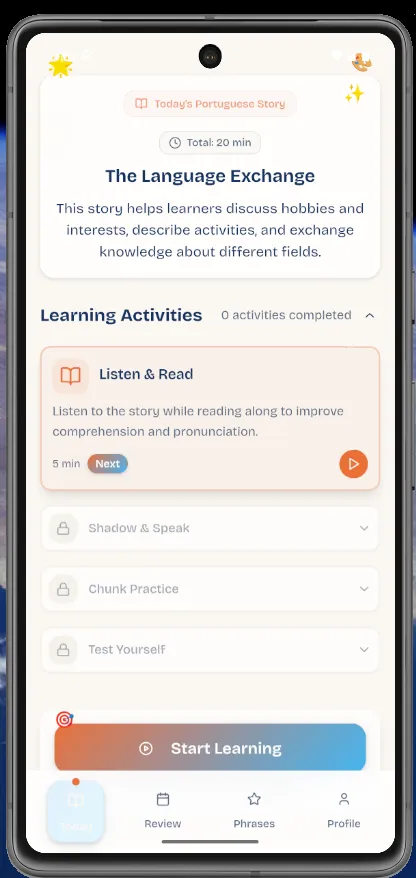
MeloLingua works in three simple steps: (1) Listen to a short story narrated by native speakers while following synchronized text, (2) Learn by tapping any word for instant translations and absorb grammar naturally through context, (3) Speak out loud and receive real-time guided pronunciation feedback. Applied linguistics summaries often find stronger vocabulary recall when words are learned in understood stories versus isolated drills — see our story-based learning research summary for sources and limits.
You can learn 12 languages with MeloLingua: Spanish, French, German, Italian, Portuguese, English, Dutch, Polish, Russian, Japanese, Korean, and Turkish. Stories are graded by CEFR level from beginner to upper-intermediate, and the deepest free web libraries — graded readers you can open without an account — currently cover Spanish, French, German, and Italian.
Yes, MeloLingua is free. Read graded stories with translations right here on melolingua.com — no signup required. The free web app at stories.melolingua.com and the Android app add native audio, tap-to-translate, and guided pronunciation practice after a quick sign-up. An iOS version is coming soon.
Story-based language learning is an approach rooted in Stephen Krashen's comprehensible input hypothesis, which states that we acquire language when we understand messages slightly above our current level. Instead of memorizing isolated vocabulary lists or grammar rules, learners absorb language naturally by engaging with compelling narratives. Published reading-intervention work often reports faster comprehension gains than drill-only classrooms; retention ranges vary by study — we summarize what is safe to claim in our 2026 statistics guide.
MeloLingua keeps read, listen, and speak on the same story scene—instead of isolated gamified drills. Duolingo focuses on short exercises and daily streaks. See our MeloLingua vs Duolingo comparison for details.