Spanish Short Stories — Free A1–B2 Reading Library
MeloLingua is a story-based reader with 24 free Spanish short stories from A1 to B2. Begin with daily routines and market errands, then move into workplace, travel, and cultural narratives. Every reader keeps Spanish first, with inline vocabulary and English translation available when meaning breaks down, plus a comprehension check to confirm what you understood.
24 free stories4 CEFR levels1–4 minutes eachEnglish support in every reader
Written by our language team · How we write comparisons · Research & statistics
Updated
Starting from zero?
Follow the Spanish A1 path, in order
8 units from "Meet someone" to "Get by on what you have", with one outcome per unit and the first 2 episodes free.
Grammar decisions through stories
Choose the right Spanish form inside a real scene
Each guide gives you one decision rule, a narrated micro-story, five explained questions, and a speaking drill. Compare the meanings first, then hear both forms doing different jobs in the same scene.
A1–B1 · narrated story
Ser vs estar
Use ser to identify or classify what something is; use estar to locate it or describe its condition in this situation.
Open the decision labA2–B1 · narrated story
Por vs para
Use por for the cause, route, means, duration, or exchange behind an action; use para for its destination, recipient, purpose, or deadline.
Open the decision labA1–B1 · narrated story
Saber vs conocer
Use saber for facts, answers, and knowing how to do something; use conocer for people, places, works, and things you are familiar with.
Open the decision labStart at the right depth
Choose your Spanish story level
Start where you can follow the event without translating every line. Move up when the plot flows and support becomes occasional.
beginner
A1 stories
Short, concrete scenes built from familiar words and everyday actions.
Browse A1 Spanish storieselementary
A2 stories
Connected events with simple reasons, time phrases, and familiar situations.
Browse A2 Spanish storiesintermediate
B1 stories
Longer plots, wider vocabulary, and enough context to infer unfamiliar language.
Browse B1 Spanish storiesupper-intermediate
B2 stories
Denser narration, nuanced viewpoints, and less predictable sentence patterns.
Browse B2 Spanish storiesbeginner · 7 stories
A1 Spanish short stories — 7 beginner readers
Short, concrete scenes built from familiar words and everyday actions.

El Café de la Mañana
María’s seven-o’clock coffee, toast with jam, and open window turn an ordinary morning.
6 glossed words
Read story →
El Mercado
Pedro visits a bustling market on a vibrant Saturday morning.
6 glossed words
Read story →
El Parque
While Sofía reads on a park bench, Max finds new playmates—and a young visitor.
6 glossed words
Read story →
El puesto de churros
Luciana follows the smell of hot oil across the plaza.
6 glossed words
Read story →
La Cena
Grandmother’s seafood paella brings the Rodríguez family to a table set.
6 glossed words
Read story →
Mi Nuevo Vecino
Carlos arrives with moving boxes and a curious green-eyed cat; Ana’s help turns an apartment.
6 glossed words
Read story →
Una llamada a mamá
After a tiring day, a short call from his mother gives Marcos the energy to make dinner.
5 glossed words
Read story →elementary · 5 stories
A2 Spanish short stories — 5 elementary readers
Connected events with simple reasons, time phrases, and familiar situations.

El Viaje en Tren
Mateo embarks on a train journey to Valencia, discovering unexpected connections.
6 glossed words
Read story →
Fin de semana en Granada
Laura combines a squeaky suitcase, a hillside mirador.
7 glossed words
Read story →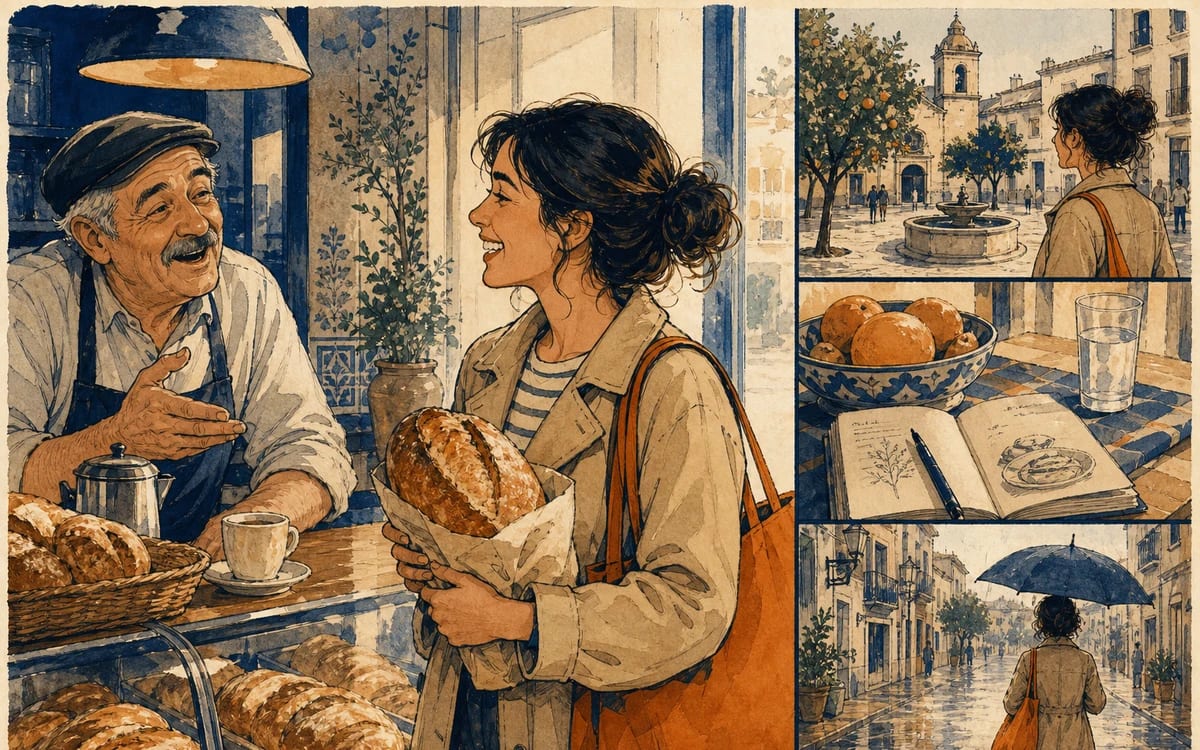
La Panadería del Sábado
Sofía goes out early for crusty bread, trades jokes.
7 glossed words
Read story →
Primer día en la oficina
Javier navigates the chaos of a new office, from logins to a bilingual microwave.
6 glossed words
Read story →
Una Tarde en la Biblioteca
Clara busca un rincón tranquilo para estudiar y se encuentra con una conversación inesperada.
6 glossed words
Read story →intermediate · 6 stories
B1 Spanish short stories — 6 intermediate readers
Longer plots, wider vocabulary, and enough context to infer unfamiliar language.

El puente de septiembre
A planned beach weekend in Cádiz turns into an unexpected exploration of a hidden cove when.
3 glossed words
Read story →
La bandeja equivocada
At a Granada bakery-café, Lucía’s pastry order disappears just.
9 glossed words
Read story →
La carta de reclamación
Sofia must draft a formal complaint letter for a dissatisfied client.
3 glossed words
Read story →
La cola en el banco
Ana joins a long bank queue in Madrid and overhears a conversation that changes her rushed.
5 glossed words
Read story →
La Feria del Libro en Madrid
At Madrid's Book Fair, Isa finds a novel, meets its author.
7 glossed words
Read story →
La fila en la farmacia
In Seville's pharmacy queue, Elena buys nasal spray.
6 glossed words
Read story →upper-intermediate · 6 stories
B2 Spanish short stories — 6 upper-intermediate readers
Denser narration, nuanced viewpoints, and less predictable sentence patterns.

El ascensor que no llega
A broken elevator in a Buenos Aires apartment building forces two neighbors from different.
3 glossed words
Read story →
El juicio
A minor property dispute in a small-town courtroom reveals a decades-old neighborhood secret.
6 glossed words
Read story →
El mercado de artesanos
A visitor at an Oaxaca artisan market discovers that a seemingly simple ceramic piece.
3 glossed words
Read story →
El vuelo reprogramado
After his flight is cancelled at the airport, Pablo goes to Atocha to book a train.
6 glossed words
Read story →
La entrevista final
The final round interview at a Mexico City corporate headquarters takes a turn when.
8 glossed words
Read story →
La renuncia por correo
After a bruising performance review, Marta drafts her resignation from a Barcelona office.
6 glossed words
Read story →Choose by learning goal
MeloLingua vs. free Spanish story sites vs. graded readers
MeloLingua is the strongest fit when short supported stories should lead into repeated listening and speaking. Free story sites suit broad browsing, while traditional graded readers are better for longer offline reading.
Swipe to compare →
| Compare | MeloLingua | Free story sites | Traditional graded readers |
|---|---|---|---|
| Reading support | Inline vocabulary, English translation, and a comprehension check across the web library | Varies by site; translations and exercises may be separate or unavailable | Usually a glossary, notes, or exercises elsewhere in the book |
| Level choice | A1 7 · A2 5 · B1 6 · B2 6 | Often uses broad beginner or intermediate labels | Usually one stated level or range per book |
| After the story | Continue with listening, vocabulary review, and speaking practice in the app | Usually self-directed reading; some sites add quizzes or audio | Often includes end-of-chapter questions or activities |
| Best fit | Short, repeatable story practice that can continue in the app | Browsing free texts from a range of publishers and formats | Longer offline reading in a curated sequence |
| Access | 24 web readers are free; the app adds personalized practice | Usually free, sometimes supported by ads or registration | Buy, borrow, or access through a library or course |
Category comparison based on the typical format of each option; individual sites and books vary.
A language-specific reading cue
Let Spanish verb endings carry the timeline
Read for who acts and when before stopping for vocabulary. At A1–A2, present and simple past forms anchor the event; at B1–B2, watch tense changes and connectors to follow how the narrator moves between background, action, and consequence.
Read the first Spanish storyAnswers
Spanish short stories — FAQ
Q01Are these Spanish short stories free?
Are these Spanish short stories free?
Yes. All 24 Spanish web readers on this page are free to read without an account. The MeloLingua app is a separate experience for personalized stories and continued listening, review, and speaking practice.
Q02Which Spanish story level should I choose?
Which Spanish story level should I choose?
Choose A1 if you need short concrete scenes and frequent support, A2 for connected everyday events, B1 for longer plots with more inference, or B2 for denser language and more nuanced viewpoints.
Q03Do the Spanish stories include English translation?
Do the Spanish stories include English translation?
24 of the 24 readers include English support. Read the Spanish first, then open the translation only when a line blocks your understanding.
Q04How is MeloLingua different from a free story site or graded reader?
How is MeloLingua different from a free story site or graded reader?
This library groups short Spanish stories by CEFR level and keeps vocabulary and translation support close to the text. The app extends the same story-first approach into listening, review, and guided speaking practice.
Learn Spanish through daily stories
MeloLingua turns graded Spanish stories into a daily habit — native audio, tap-to-translate vocabulary, and speaking drills matched to what you read.
More free graded readers
Explore story libraries in five more languages
Keep the same read-for-meaning routine and switch languages. Every library is free to browse, with level guidance and English support.