Last updated
Language Learning7 Best Duolingo Alternatives in 2026 (Free & Tested)
We tested 7 Duolingo alternatives for 30 days, free and paid. See which app beats Duolingo for reading, speaking, listening, or vocabulary.
Written by our language team · Method: Editorial Policy
We used all seven apps on Android across Spanish and French during a 30-day review window in January–February 2026. We compared skill depth, feedback, context, daily friction, access, and learner fit; then rechecked volatile product and pricing claims against official documentation on August 13, 2026.
Tested for 30 days: keep the useful habit, replace the weak practice.
The best Duolingo alternative in 2026 depends on what you need next. Choose MeloLingua for connected story input, Pimsleur for audio recall, italki for live conversation, Anki for spaced repetition, LingQ for native-content reading, Busuu for a structured course, or Beelinguapp for parallel text. For microphone-based practice specifically, compare the leading pronunciation-feedback apps.
Disclosure: MeloLingua publishes this review and appears in it. No company paid for placement. Our access to MeloLingua is deeper than our competitor access, so hands-on observations are separated from official-source checks, and the review does not claim comparative fluency outcomes.
Is there an app better than Duolingo?
Not better at everything, and not worse at everything. Duolingo is hard to beat at building a daily habit and introducing beginner vocabulary. It gives comparatively little connected listening, long-form reading, or unscripted speaking, so a second app usually closes the gap faster than a full replacement. If your blocker is connected stories, MeloLingua fits: full narration with synchronized text, tap-to-translate, and speaking practice on lines you have already understood. If it is spontaneous conversation, italki beats every self-study app. If it is recall, Anki wins. The honest answer is that “better than Duolingo” depends on the skill you are trying to fix this month.
Try a free story at your level and judge the difference before you switch anything.
What is the #1 language learning app?
There is no single number-one app for every learner. In this test, MeloLingua is the strongest story-first option, italki wins for live conversation, Pimsleur for hands-free audio, Anki for vocabulary retention, LingQ for extensive reading, Busuu for structure, and Beelinguapp for parallel text.
Comparing a different app too? Browse the complete language-learning app comparison guide for LingQ, Babbel, Busuu, Beelinguapp, Pimsleur, Readlang, and StoryLearning.
Choosing specifically between these two apps? Read the MeloLingua vs Duolingo comparison for a direct feature-by-feature decision.
Best Duolingo alternatives compared (2026)
| App | Strongest skill | Best for | Languages | Price model | Main limitation |
|---|---|---|---|---|---|
| MeloLingua | Connected reading + listening | Story learners who want low-pressure speaking reps | 13 in app; deepest public web libraries in 4 | Free core story loop | No live tutors; lighter grammar sequence |
| Pimsleur | Audio recall + pronunciation | Hands-free study while commuting or walking | 50+ | About $20/month; plan and market vary | Reading and writing remain secondary |
| italki | Spontaneous conversation | Learners ready for live correction | 150+ | Tutor-set per-lesson marketplace pricing | Tutor quality, scheduling, and cost vary |
| Anki | Long-term vocabulary retention | Self-directed learners who will build or curate cards | Any | Free on web/desktop/Android; paid iOS app | Setup work; no course or conversation |
| LingQ | Native-content reading | Independent learners who bring their own interests | 50+ | Regional subscription; longer plans discounted | Open-ended reading can overwhelm beginners |
| Busuu | Structured CEFR-style progression | Learners who want sequence and community feedback | 14 | Free access; Premium varies by term/region | Best features sit behind Premium |
| Beelinguapp | Parallel-text reading | Learners who need side-by-side translation | 22 listed learning languages | Free access; Premium varies by store/region | Translation can become a crutch |
Price and feature check: access models were rechecked against official pages from Pimsleur, italki, Anki, LingQ, Busuu, and Beelinguapp on August 13, 2026. We avoid false price precision where checkout varies by country, currency, store, promotion, plan length, or tutor.
By the numbers
Review scope: 7 apps, 2 target languages, and a 30-day Android review window in January–February 2026, assessed across 6 decision criteria.
Reading coverage: Nation (2006) distinguishes about 95% known words as a minimum that still leaves substantial unknown vocabulary from roughly 98% coverage, the level associated with more independent reading.
Evidence rule: hands-on observations describe the tested Android flows; catalog, feature, and price claims come from dated official sources; neither proves comparative fluency outcomes.
Review methodology
How we tested these Duolingo alternatives
We used all seven products on Android across Spanish and French during a 30-day review window in January–February 2026. We did not record equal minutes in every app, purchase every premium tier, or test iOS. On August 13, we rechecked language coverage, access models, prices, and volatile features against official documentation. Hands-on use describes a routine; vendor documentation confirms its current catalog and checkout terms.
Six decision criteria
- Skill depth: reading, listening, speaking, writing, or recall
- Quality of feedback and correction
- Context: connected discourse versus isolated prompts
- Daily friction: setup, scheduling, and session length
- Free-tier usefulness and paid-plan clarity
- Who should choose it — and who should not
Evidence labels and limits
- Hands-on: observations from the 30-day Android review window.
- Source-verified: feature, catalog, and price-model claims checked on official pages.
- Not measured: retention, fluency gains, or long-term comparative outcomes.
- Conflict: MeloLingua is our product, so its access is deeper and its weaknesses are disclosed explicitly.
Inside the story-first option
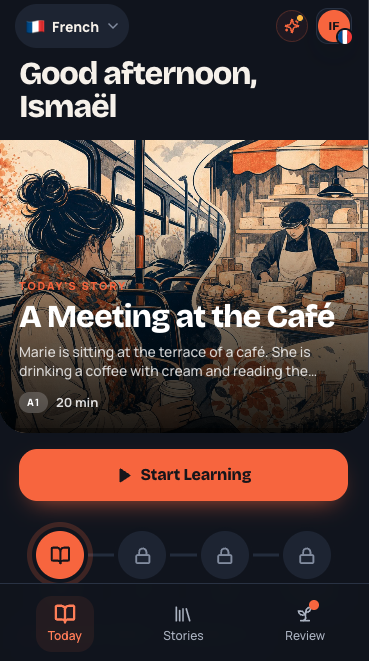
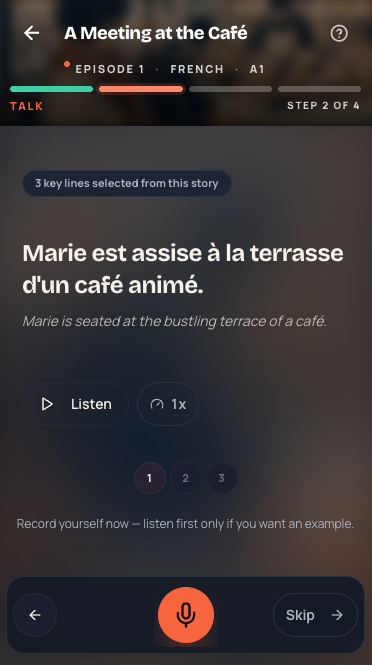
MeloLingua product screenshots
These product screenshots show the sequence behind our story-first recommendation: one story moves from Listen & Read into Shadow & Speak, chunk practice, and a quiz instead of resetting to an unrelated drill. Competitor interfaces change frequently; use the official product links below for their latest screens.
Why People Look for Duolingo Alternatives
Duolingo is effective at lowering the friction of a daily language habit. The reason to add or switch apps is not that Duolingo is “bad”; it is that a broad gamified course may stop matching the specific skill you need next. Common signals include:
- Conversation still freezes. Recognizing or arranging a sentence is different from producing an unscripted answer to another person.
- Connected language feels difficult. A paragraph, story, or podcast creates discourse-level listening demands that isolated prompts cannot fully reproduce.
- Listening comprehension plateaus. Recognizing short clips does not automatically create stamina for longer native speech.
- The metric becomes the goal. XP and streaks measure app activity; the Council of Europe’s CEFR Companion Volume (2020) uses can-do descriptors to describe what a learner can understand and communicate.
The alternatives below address these gaps in different ways. A practical approach is to combine one primary method with one supplement — for example, a story app for daily input and an italki lesson for periodic conversation checks.
Before switching apps entirely, identify which skill is actually blocking you. If you recognize every word on flashcards but freeze in conversation, you need listening and speaking exposure — not more grammar drills. If you understand podcasts but cannot read a menu, you need graded reading with audio support. Duolingo spreads effort across all four skills at a beginner level; the alternatives below let you go deep on the one that matters most right now.
Price also varies widely: MeloLingua and Anki provide useful free practice, Pimsleur’s official guide places its subscription at about $20 per month, and italki charges by lesson. LingQ, Busuu, and Beelinguapp vary by region, term, store, or promotion. Factor in realistic usage: one paid conversation you attend can be more useful than a cheap subscription you rarely open.
MeloLingua
- Best for
- Learners who want to build comprehension through engaging stories
- Languages
- 13 in the app; deepest free web libraries in Spanish, French, German, and Italian
- Price
- Free to start
MeloLingua takes a fundamentally different approach from Duolingo. Instead of isolated sentences and gamified drills, you learn by listening to complete stories narrated by native speakers. Each story has synchronized text so you can follow along, with tap-to-translate for any word you don’t know.
The method applies comprehensible input: the story should be understandable enough to follow while still containing useful new language. Native audio and fast glosses keep meaning available; short speaking reps then reuse lines the learner has already understood.
What makes it different from Duolingo
- Full stories instead of isolated sentences
- Native speaker audio for every story
- Pronunciation feedback in story practice
- Generate personalized stories about your interests
- No gamification pressure — learn at your own pace
Honest limitations
- The deepest free public story libraries currently cover four of the app’s 13 languages
- No marketplace for live tutors or spontaneous human conversation
- Story progression is less explicit than a full grammar-first curriculum
- Android and web are available; iOS is still on the waitlist
Verdict: choose MeloLingua when connected stories, native audio, and low-pressure speaking reps are the missing practice. Choose a tutor marketplace or a grammar-first course instead when live correction or explicit sequencing is the priority.
Pimsleur
Best for: Learners who prefer audio-only learning (commuting, exercising)
Languages: 50+ languages
Price: About $20/month; lifetime purchase options vary by course and promotion
Pimsleur centers each course on 30-minute audio lessons with prompted recall. Its current app also includes Voice Coach, which uses AI recognition for real-time pronunciation feedback in most languages and falls back to record-and-compare practice where automated feedback is unavailable.
Strengths: predictable audio routine, hands-free core lessons, and source-verified pronunciation feedback. Limitations: reading and writing remain secondary, and the repeated audio format will not suit every learner.
Verdict: choose Pimsleur for a reliable hands-free speaking routine. Pair it with a reading tool if written comprehension and longer texts matter to your goal.
italki
Best for: Learners who want real conversation practice with native speakers
Languages: 150+ languages
Price: Tutor-set per-lesson pricing; no course subscription required
italki is the only option in this list built around scheduled one-to-one lessons with a real teacher or community tutor. That makes it the clearest choice when the missing skill is unscripted turn-taking and human correction rather than another self-study course.
Strengths: live conversation, personalized feedback, and flexible teacher choice. Limitations: scheduling and cost vary, and the curriculum depends on the tutor you select.
Verdict: choose italki when spontaneous speaking and human correction are the bottleneck. It works best as scheduled practice, not as a frictionless daily course.
Anki
Best for: Systematic vocabulary building with long-term retention
Languages: Any (user-created decks)
Price: Free on desktop, web, and Android; official iOS app is a one-time purchase
Anki is a configurable flashcard system that schedules reviews from your recall ratings. It supports text, audio, images, shared decks, and user-created material, so it works with any language for which you can create or find useful cards.
Strengths: precise review control, broad media support, and free desktop, web, and Android access. Limitations: setup and card quality are your responsibility; Anki supplies no course, connected input, or conversation partner.
Verdict: choose Anki for deliberate vocabulary retention, especially with words collected from material you already read or heard. Treat it as a supplement rather than a complete language course.
LingQ
Best for: Intermediate-advanced learners who want to read native content
Languages: 50+ languages
Price: Regional subscription pricing; longer plans reduce the monthly equivalent
Created by polyglot Steve Kaufmann, LingQ lets you import any content (articles, books, podcasts) and turns it into an interactive learning experience. You highlight unknown words, build vocabulary lists, and track your progress through real content.
Strengths: a large content library, unlimited imports on Premium, saved-word tracking, and broad language coverage. Limitations: the free plan is restrictive, and the open-ended workflow can require more learner planning than a course path.
Verdict: choose LingQ when you are ready to learn through self-selected books, articles, podcasts, and videos. Beginners who want a prescribed sequence may find Busuu easier to start.
Busuu
Best for: Learners who want a Duolingo-like structure with more depth
Languages: 14 languages
Price: Free access; Premium price varies by term, promotion, and region
Busuu publishes 14 CEFR-aligned courses, with coverage ranging from A1–A2 to A1–C1 depending on the language. Learners can submit written or spoken exercises to the Community for corrections, while short lessons provide a more explicit course sequence than open-ended input tools.
Strengths: clear sequence, published CEFR ranges, and human community corrections. Limitations: course depth differs by language, corrections are not guaranteed immediately, and Premium unlocks additional features.
Verdict: choose Busuu when a CEFR-aligned path and explicit course sequence reduce planning friction. Add live lessons elsewhere if immediate, unscripted interaction is essential.
Beelinguapp
Best for: Learners who enjoy reading with side-by-side translations
Languages: 22 learning languages listed on the official site
Price: Free access; Premium pricing varies by app store and region
Beelinguapp presents the target language and a familiar language side by side while native narration plays. Its official catalog currently lists 22 learning languages, with free access and a Premium tier that removes ads and unlocks the full content library.
Strengths: low-friction parallel reading, native narration, and broad language coverage. Limitations: the translation column can dominate attention, and pronunciation correction is not the product’s primary job.
Verdict: choose Beelinguapp when side-by-side translation removes enough friction to keep you reading. Move toward target-language-only text as comprehension improves.
If side-by-side reading is what you like but you also want speaking practice, compare the full Beelinguapp alternative guide.
What is the best free Duolingo alternative?
MeloLingua and Anki are the strongest free options, and they do different jobs. MeloLingua’s free story loop covers Spanish, French, German, Italian, Korean, and Russian with narration, tap-to-translate, and speaking practice. Anki is free on desktop, web, and Android and is the better choice if you want scheduled vocabulary review over a long period.
A free plan is only useful if it still contains the practice you actually need. Check three things before committing:
- How much content is free? MeloLingua’s public web libraries are deepest in Spanish, French, German, and Italian. Beelinguapp and Busuu offer free access, but their paid tiers unlock more of the library or the better features.
- Is the free tier the real method? With MeloLingua and Anki, the free experience is the method itself rather than a sample of it.
- What will you pay for later? A paid conversation lesson you actually attend can be worth more than a cheap subscription you rarely open.
If none of the free options fits, the skill-by-skill comparison below narrows the paid alternatives by the bottleneck you want to fix.
Which Alternative Is Right for You?
Choose by the skill you need next
| Your bottleneck | Best first choice | Why | Useful second tool |
|---|---|---|---|
| Connected listening still feels hard | MeloLingua | Graded story audio stays attached to readable context | Pimsleur for audio-only recall |
| You freeze in live conversation | italki | A real tutor creates spontaneous turns and correction | MeloLingua for lower-pressure rehearsal |
| New words disappear after a week | Anki | Scheduled retrieval targets memory directly | LingQ to find words in authentic input |
| You need a clear course sequence | Busuu | Structured lessons and explicit explanations reduce planning | italki for live use |
| You want to read native material | LingQ | Imports and word tracking support extensive reading | Anki for selected vocabulary |
| You need translation beside every line | Beelinguapp | Parallel text removes lookup friction | MeloLingua when ready to rely less on English |
| Your study time is hands-free | Pimsleur | Audio prompts work without a screen | MeloLingua when you can read and listen together |
The best Duolingo alternative depends on what’s missing from your learning:
- If you can’t follow connected speech: MeloLingua adds story-length listening with readable context. Start with graded Spanish stories or French stories at A1–A2 before jumping to native podcasts.
- If you need conversation practice: italki. Nothing replaces real human conversation — book a 30-minute session every week and prepare three questions in advance so you are not staring at a blank screen.
- If you struggle with vocabulary retention: Anki makes scheduled retrieval the main activity. Import a small number of useful words from content you actually read rather than accumulating random premade cards.
- If you want hands-free learning: Pimsleur. Audio lessons you can do while driving or exercising; pair with MeloLingua reading sessions on days you are at a desk.
- If you want more structure: Busuu. CEFR-aligned courses with grammar explanations when you need explicit rules before immersion feels comfortable.
- If you read better with translation support: Beelinguapp for parallel text, then graduate to MeloLingua once you can follow stories without constant English lookup.
A practical combination uses one primary method and one supplement. For example: MeloLingua for daily connected input, Anki for a small vocabulary queue, and an occasional italki lesson for conversation. Do not turn every tool into a competing daily obligation; each app should have one clearly defined job.
If pronunciation is the bottleneck rather than general course structure, use the separate AI pronunciation app comparison. It distinguishes phoneme-level diagnosis, prompt-level acceptance, conversation feedback, and guided sentence practice instead of treating every microphone feature as equivalent.
Balanced verdict
The honest limitation of every option
Every app concentrates practice and therefore leaves something out. That is useful when the concentration matches your bottleneck — and frustrating when it does not.
MeloLingua: deep story libraries in only four of its 13 languages, no live tutors, and less grammar sequencing than a course-first app.
Pimsleur: strong audio routine, but limited visual reading and writing work.
italki: real interaction, but quality, cost, scheduling, and teaching style vary by tutor.
Anki: powerful retrieval, but you must select content and it will not create conversation by itself.
LingQ: broad input, but the interface and open-ended workflow can overwhelm beginners.
Busuu: clear structure, but Premium gates some depth and community feedback is not immediate.
Beelinguapp: accessible parallel reading, but the English column can become the path of least resistance.
Duolingo: excellent habit mechanics, but streak activity should not be mistaken for a complete measure of communicative ability.
References
Research basis
These independent sources support the reading-coverage and proficiency-framework claims in this review. They do not rank or endorse any language-learning app.
- •Nation, I. S. P. — vocabulary coverage for reading and listening (2006) — Explains the distinction between a 95% minimum and roughly 98% coverage for unassisted reading.
- •Council of Europe — CEFR Companion Volume (2020) — Proficiency descriptors used to distinguish activity from measurable communicative ability.
Read your first story
Try a free A1 story in Spanish, French, German, Italian or Portuguese
Native audio on every story, tap-to-translate vocabulary, and speaking practice on the same lines — no card required.
Answers
Frequently asked questions
Q01What are the best alternatives to Duolingo in 2026?
What are the best alternatives to Duolingo in 2026?
The best Duolingo alternatives in 2026 include MeloLingua for story-based learning with pronunciation feedback, Pimsleur for audio conversation, italki for live tutoring, Anki for spaced repetition, LingQ for input-based reading, Busuu for structured CEFR lessons, and Beelinguapp for parallel-text reading.
Q02Why do people look for Duolingo alternatives?
Why do people look for Duolingo alternatives?
Learners usually look for Duolingo alternatives when a streak no longer improves the skill they care about. Typical gaps are sustained listening, spontaneous speaking, long-form reading, explicit grammar, or feedback from another person. The right replacement is therefore skill-specific — a tutor for conversation, stories for connected input, or SRS for vocabulary retention.
Q03Is Duolingo enough to become fluent?
Is Duolingo enough to become fluent?
Duolingo can build a useful beginner habit and introduce vocabulary, but one app rarely supplies enough connected listening, spontaneous conversation, reading volume, and corrective feedback for broad fluency. Keep it if it sustains your routine, then add the missing practice — graded stories, live conversation, or extensive input — based on your current bottleneck.
Q04What is the best language learning app for adults?
What is the best language learning app for adults?
The best language learning app for an adult is the one that matches both the goal and the routine. Choose MeloLingua for short story sessions, Pimsleur for hands-free audio, italki for live conversation, Anki for deliberate vocabulary review, LingQ for native-content reading, or Busuu for a structured course. No single method wins every skill.
Q05What is the number one language learning app?
What is the number one language learning app?
There is no universal number-one language learning app because different tools train different skills. Among the seven apps tested here, MeloLingua is the strongest story-first choice, italki is best for live conversation, Pimsleur for hands-free audio recall, Anki for vocabulary retention, LingQ for extensive reading, Busuu for structured coursework, and Beelinguapp for parallel text.
Q06What are the top five language learning apps in 2026?
What are the top five language learning apps in 2026?
Five strong language learning apps in 2026 are MeloLingua for connected stories, italki for live tutoring, Pimsleur for audio-first speaking practice, Anki for spaced-repetition vocabulary review, and Busuu for a structured CEFR-aligned course. LingQ and Beelinguapp also belong on the shortlist when extensive reading or parallel text is the learner's main priority.
Q07Is MeloLingua a good Duolingo alternative for story learners?
Is MeloLingua a good Duolingo alternative for story learners?
Yes, if your priority is connected reading and listening rather than a large course tree. MeloLingua teaches 13 languages in the app and publishes its deepest free web libraries for Spanish, French, German, and Italian. Its limitations are no live tutors and less explicit grammar sequencing than a course-first app such as Busuu.
Q08What is the best free Duolingo alternative?
What is the best free Duolingo alternative?
MeloLingua and Anki are the strongest free choices for different jobs. MeloLingua offers free graded story practice for Spanish, French, German, Italian, Korean, and Russian; Anki offers free desktop, web, and Android spaced repetition for any language. Beelinguapp and Busuu also have free access, but their paid tiers unlock more content or features.
Q09Which Duolingo alternative is best for speaking?
Which Duolingo alternative is best for speaking?
italki is the strongest option for spontaneous speaking with a real person because lessons provide live interaction and correction. Pimsleur is better for hands-free prompted speaking, while MeloLingua is useful for lower-pressure pronunciation practice on story lines you have already heard and understood. Choose based on whether you need conversation, repetition, or pronunciation confidence.
Q10How did MeloLingua review these Duolingo alternatives?
How did MeloLingua review these Duolingo alternatives?
The team used all seven products on Android across Spanish and French during a 30-day review window in January and February 2026. The comparison covered six practical criteria, while language counts, access models, prices, and volatile features were rechecked against official documentation on August 13, 2026. Testing time and premium access were not equal across every app.
Tagged