Current product
The same story stays with you from reading to speaking
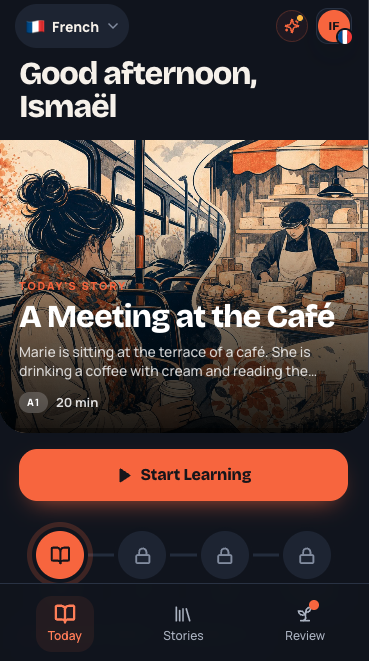
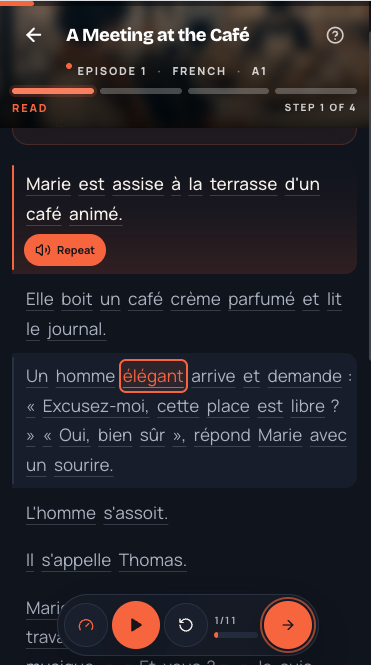
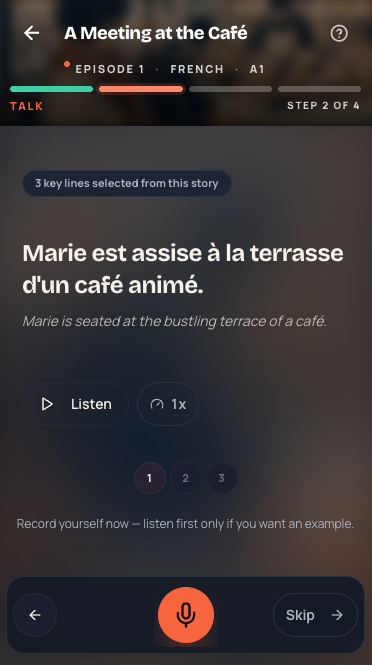
Choose a level-matched story, follow the narration, then speak lines from the same scene. These screens show the current small-device experience.
Free · Android & web
MeloLingua is a story-first language app with daily personalized stories, narration, tap-to-translate vocabulary, and guided speaking practice. Start with the free tier on web or Android.
Quick answer
A story language app centers full narratives instead of isolated drills: you listen and read along, learn vocabulary in context, and rehearse sentences from the same story. MeloLingua adds personalized story topics and level-aware difficulty so the input stays in the “sweet spot” Krashen called comprehensible input. Preview the format with free Spanish short stories or French short stories.
Current product
Choose a level-matched story, follow the narration, then speak lines from the same scene. These screens show the current small-device experience.
Three connected moves grounded in comprehensible input and built around listening, reading, and speaking in context. For why MeloLingua centers repeatable real-life scenes instead of isolated drills, read the founder method note.
Every day, discover a new narrated story. Generate personalized stories about your interests — from space exploration to Italian cuisine — or choose from the curated library at your level.
Follow synchronized text while listening. Tap any word for instant translation. Your brain absorbs grammar and vocabulary naturally through context — the way children learn their first language.
Practice speaking sentences from the story. MeloLingua compares your attempt with the reference narration so you can focus on lines that need another repetition.
Story-based language learning is grounded in decades of research. Personalization keeps difficulty in range while you collect reps.
Meaning Before Memorization
A story gives each new word a speaker, situation, and consequence. That context supports inference and makes later encounters easier to recognize.
Turn Input Into an Attempt
Repeating a line from an understood scene asks you to retrieve its sound and phrasing, instead of only recognizing it on screen.
Return Over Time
Research on distributed practice supports revisiting material across separate sessions. MeloLingua uses short sessions and saved phrases to make those returns practical.
Linguist Stephen Krashen's Input Hypothesis (1985) states that we acquire language when we understand messages slightly above our current level — a concept known as i+1. Stories are the ideal delivery mechanism for comprehensible input because they provide natural context, narrative structure, and emotional engagement.
Adaptive story difficulty and topic choices help keep you in the optimal i+1 band, while guided speaking practice turns what you heard into confident output.
Read the full science guide →Create stories about your interests. Choose themes like cooking, space, or football, and get a personalized story with vocabulary directly relevant to your life. No more generic dialogues about ordering coffee.
Follow the reference narration while the current sentence stays visible. Replay a line before moving into speaking practice.
Speak sentences from the story and get clear, immediate guidance against the reference narration, then repeat the lines that need more attention.
Tap any word in a story for an instant contextual definition. No need to switch to a dictionary. The meaning is shown in the context of the sentence, helping your brain form natural associations.
How MeloLingua compares to other story-first and personalized language apps in 2026.
| App | Generated stories | Personalized Topics | Speaking feedback | Languages | Price |
|---|---|---|---|---|---|
| MeloLingua | Yes | Yes | Yes | 12 in app; 6 free web libraries (4 through B2) | Free |
| StoryLearning | No (human-authored) | No | No | Multiple | Paid courses |
| Beelinguapp | Partial | No | No | Multiple | Free + paid plan |
| StoryLing | Yes | Yes | No | Limited selection | Check official site |
| Langua | Mini-stories only | Limited | Yes | Multiple | Paid plan |
| Duolingo | No (scripted stories) | No | Basic | 40+ | Free + paid plans |
MeloLingua facts verified September 4, 2026. Competitor details are directional; confirm current availability on each official product site before choosing.
Browse account-free graded stories in Spanish, French, German, Italian, Korean, and Russian. The first four extend to B2; Korean and Russian currently cover A1 and A2.
Answers
A story language app teaches through full narratives you can listen to and read along with, instead of disconnected drills. MeloLingua layers in personalized topics, level-aware difficulty, tap-to-translate vocabulary, and guided pronunciation practice so the same story session trains comprehension and speaking — the core idea behind comprehensible input.
Yes. MeloLingua is free. You can read graded stories with translations on melolingua.com with no signup required. The free app — daily stories, the personalized story generator, vocabulary tools, and guided pronunciation practice — is on Android via the Google Play Store (iOS coming soon) and on the web at stories.melolingua.com after a quick sign-up.
Personalization helps in three ways: (1) Stories can follow your interests, so the vocabulary you hear matches real life. (2) Difficulty can stay near the optimal comprehensible input level (i+1), so you stay challenged without stalling. (3) Guided pronunciation feedback turns lines from the same story into speaking reps, building intelligibility faster than passive reading alone.
MeloLingua turns reading into active language practice through stories, vocabulary, pronunciation, listening and speaking. Duolingo focuses on short gamified exercises and daily streaks.
Stories can be an effective source of comprehensible input because context helps learners infer meaning and notice how words work together. Reading alone is not a complete language program, so MeloLingua adds listening, retrieval, and speaking practice. Results depend on level match, repetition, and consistency; our research guide links the underlying studies and explains their limits.
The app supports 13 target languages: Spanish, French, German, Italian, Portuguese, English, Arabic, Dutch, Polish, Russian, Japanese, Korean, Turkish. Free graded web readers currently cover Spanish, French, German, Italian, Korean, and Russian. Spanish, French, German, and Italian extend from A1 to B2; Korean and Russian currently focus on A1 and A2.
MeloLingua is a strong choice for learners who want personalized stories, narration, tap-to-translate vocabulary, and guided speaking drills anchored to the same lines. Beelinguapp may fit readers who prioritize parallel text, while tutor or conversation products are a better fit when live human interaction is the main goal.
The science behind story-based language learning and Krashen's input hypothesis.
What to expect from real-time speaking support inside story sessions.
Compare story-based immersion with gamified drill practice.
See what to look for in a Spanish app built around stories.
Compare the top language learning apps beyond gamified drills.
Free tier. No credit card to start. Build one short session around story narration, tap-to-translate vocabulary, and speaking drills matched to what you read.
Review these words right before you would forget them



'%20transform='translate(89.8%20.4)scale(.9375)'%3e%3cpath%20fill='%23fff'%20d='M-95.8-.4H587v512H-95.8Z'/%3e%3cg%20transform='rotate(-56.3%20361.6%20-101.3)scale(10.66667)'%3e%3cg%20id='kr-c'%3e%3cpath%20id='kr-b'%20fill='%23000001'%20d='M-6-26H6v2H-6Zm0%203H6v2H-6Zm0%203H6v2H-6Z'/%3e%3cuse%20xlink:href='%23kr-b'%20width='100%25'%20height='100%25'%20y='44'/%3e%3c/g%3e%3cpath%20stroke='%23fff'%20d='M0%2017v10'/%3e%3cpath%20fill='%23cd2e3a'%20d='M0-12a12%2012%200%200%201%200%2024Z'/%3e%3cpath%20fill='%230047a0'%20d='M0-12a12%2012%200%200%200%200%2024A6%206%200%200%200%200%200Z'/%3e%3ccircle%20cy='-6'%20r='6'%20fill='%23cd2e3a'/%3e%3c/g%3e%3cg%20transform='rotate(-123.7%20191.2%2062.2)scale(10.66667)'%3e%3cuse%20xlink:href='%23kr-c'%20width='100%25'%20height='100%25'/%3e%3cpath%20stroke='%23fff'%20d='M0-23.5v3M0%2017v3.5m0%203v3'/%3e%3c/g%3e%3c/g%3e%3c/svg%3e)
