Read & listen
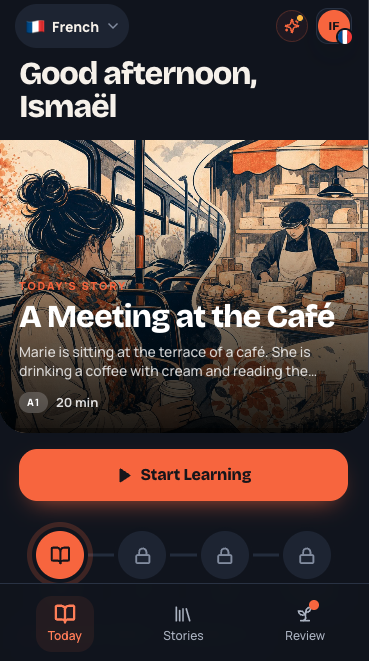
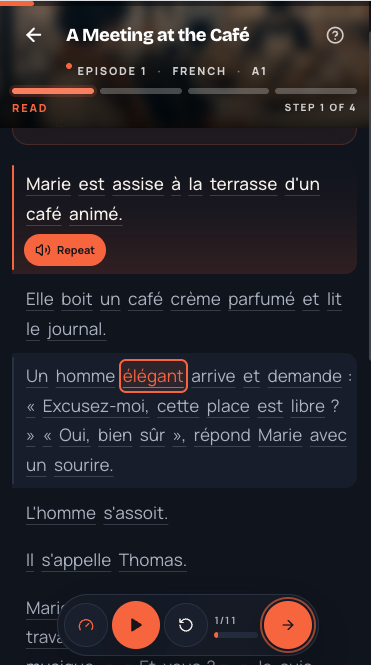
Open a graded story at your CEFR band. Story narration plays with chunk-friendly text, so listening begins with meaning instead of isolated word lists.
Product guide
A clear overview for learners, teachers, and journalists: MeloLingua replaces flashcard loops with story-led input, translation support when you need it, and speaking reps tied to the narrative.
One-sentence answer
MeloLingua is a story-based language learning app where you read and listen to level-matched narratives, reveal meaning support when needed, and practice pronunciation on lines you already understood — structured like a coach, not a streak minigame.
Last updated:
Inside the product
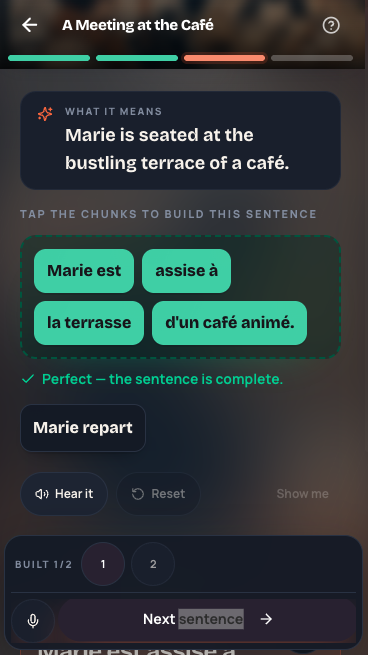
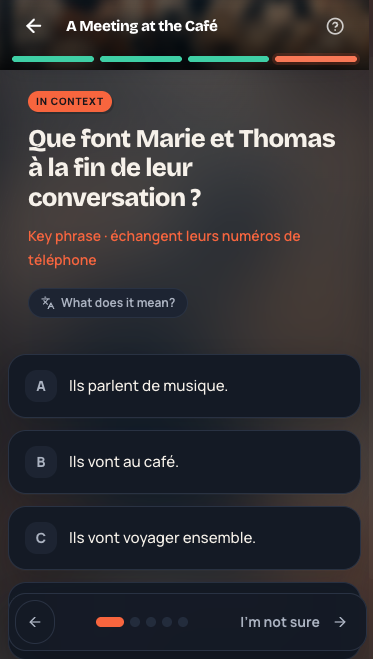
The current experience moves through Listen & Read, Shadow & Speak, Chunk Practice, and a short quiz. Saved phrases and review tools keep useful language tied to the story where it appeared.
Availability: Web app + Android app. The native iOS app is still in preparation.
Format
Short stories + speaking reps
Languages
13 in app · 6 free web libraries
Levels
Beginner to upper-intermediate (A1–B2)
Platforms
Web app + Android app
Daily loop
Four moves, repeated — the same structure in the app and on the web reader.
Open a graded story at your CEFR band. Story narration plays with chunk-friendly text, so listening begins with meaning instead of isolated word lists.
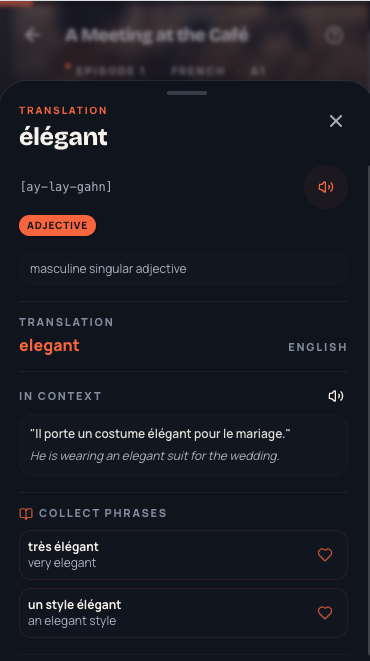
Tap for glosses or bilingual support only when meaning blocks you. Vocabulary, grammar, and rhythm stay tied to what the character actually said.
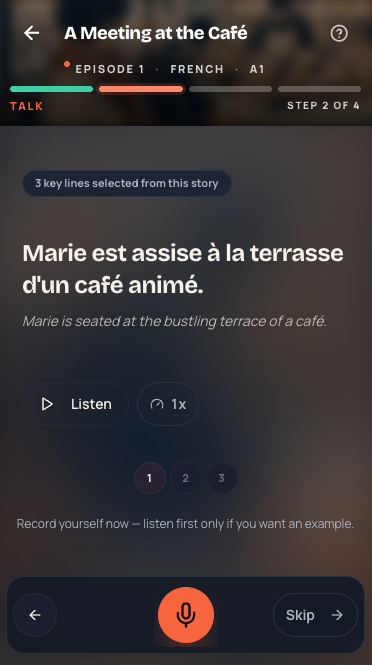
Shadow and pronounce sentences from the story you just heard. Feedback attaches to real lines, not random drill cards.
Daily sessions compound exposure. Progress tracks finished stories and speaking reps — not a streak badge with nothing behind it.
Positioning
Typical flashcard app
MeloLingua
Catalog
13 target languages in the app; free web readers in Spanish, French, German, Italian, Korean, Russian. The links above open all six account-free web libraries.
Method
The experience aligns with comprehensible input: material should be mostly understandable, slightly challenging, and worth finishing. Stories keep grammar and vocabulary tied to scenes so patterns feel natural instead of abstract. For the founder experience behind that design, read why MeloLingua starts from real weekly situations.
Why MeloLingua starts from real weekly situations instead of dictionary-first memorization.
Why mostly-understandable material beats grinding flashcards.
How narrative context anchors grammar and vocabulary.
When MeloLingua fits — and when another tool might.
Built for
Not the best fit if
Trust & editorial
Guides, comparisons, and research summaries on this site are written and reviewed by the in-house editorial team — the same group that levels stories and shapes learner-facing copy in the app.
Answers
MeloLingua is a story-based language learning app. You read and listen to short narratives at your level, reveal translations when meaning is blocked, review phrases in context, and practice pronunciation on lines from the same story.
The app supports 13 target languages: Spanish, French, German, Italian, Portuguese, English, Arabic, Dutch, Polish, Russian, Japanese, Korean, Turkish. Free graded web readers currently cover Spanish, French, German, Italian, Korean, and Russian. Spanish, French, German, and Italian extend from A1 to B2; Korean and Russian currently focus on A1 and A2.
Flashcard apps optimize for recalling isolated words. MeloLingua optimizes for comprehending full scenes — vocabulary, grammar, rhythm, and culture arrive together so meaning anchors memory. You finish stories, not just clear queues.
Pick a story at your level, read and listen to the narration, use glosses only when stuck, then run shadow-and-speak drills on lines from that story. Sessions are short enough to repeat daily and structured enough that exposure compounds over weeks.
You can read every graded story on melolingua.com without an account. The app also has a free tier. Reference prices are $11.90 monthly or $69 yearly. The exact local price is shown before purchase.
The native iOS app is not publicly available yet. iPhone users can use the web app at stories.melolingua.com in mobile Safari and join the iOS waitlist. Android is live on Google Play.
Committed learners roughly from beginner through advanced intermediate who want deliberate immersion — people tired of gamified streaks alone and ready for story-led input plus speaking reps.
The MeloLingua Editorial Team includes language teachers, translators, and language-learning researchers. Publishing standards live in our Editorial Policy.
Try it
Build your path on the web in under a minute — native narration, pronunciation drills, and stories matched to your level. Android app available too.



'%20transform='translate(89.8%20.4)scale(.9375)'%3e%3cpath%20fill='%23fff'%20d='M-95.8-.4H587v512H-95.8Z'/%3e%3cg%20transform='rotate(-56.3%20361.6%20-101.3)scale(10.66667)'%3e%3cg%20id='kr-c'%3e%3cpath%20id='kr-b'%20fill='%23000001'%20d='M-6-26H6v2H-6Zm0%203H6v2H-6Zm0%203H6v2H-6Z'/%3e%3cuse%20xlink:href='%23kr-b'%20width='100%25'%20height='100%25'%20y='44'/%3e%3c/g%3e%3cpath%20stroke='%23fff'%20d='M0%2017v10'/%3e%3cpath%20fill='%23cd2e3a'%20d='M0-12a12%2012%200%200%201%200%2024Z'/%3e%3cpath%20fill='%230047a0'%20d='M0-12a12%2012%200%200%200%200%2024A6%206%200%200%200%200%200Z'/%3e%3ccircle%20cy='-6'%20r='6'%20fill='%23cd2e3a'/%3e%3c/g%3e%3cg%20transform='rotate(-123.7%20191.2%2062.2)scale(10.66667)'%3e%3cuse%20xlink:href='%23kr-c'%20width='100%25'%20height='100%25'/%3e%3cpath%20stroke='%23fff'%20d='M0-23.5v3M0%2017v3.5m0%203v3'/%3e%3c/g%3e%3c/g%3e%3c/svg%3e)
