98%
of words on a page you need to know before reading feels comfortable without a dictionary
Vocabulary research (Paul Nation, 2006)
Choose MeloLingua if you want bilingual stories to become listening and speaking practice. Choose Beelinguapp if your main goal is simple parallel-text reading.
Beelinguapp is a clean way to read side-by-side text. MeloLingua keeps the bilingual story advantage, then adds story narration, level-aware sessions, and pronunciation reps tied to the same lines.
Written by our language team· Updated · How we write comparisons
Source and disclosure: MeloLingua publishes this comparison and appears in it. Product facts are checked against official sources; recommendations are editorial judgments about how each app fits a learning routine, not controlled evidence that one app produces better outcomes.
By the numbers
Reading and listening inside a story — with help when you need it — helps many people remember words better than flashcards alone.
98%
of words on a page you need to know before reading feels comfortable without a dictionary
Vocabulary research (Paul Nation, 2006)
95%
known-word coverage is a practical minimum for supported reading, but still leaves frequent unknown words
Vocabulary research (Paul Nation, 2006)
A1–B2
the current level range used for MeloLingua story sessions and public graded readers
MeloLingua product fact · verified August 13, 2026
Side by side
This table compares how you actually practice — not brand hype. We say where Beelinguapp still wins; see the verdict cards below.
MeloLingua vs Beelinguapp — side-by-side comparison
| Topic | MeloLingua | Beelinguapp |
|---|---|---|
| Reading format | Story sessions with tap-to-translate vocabulary | Parallel text side by side |
| Audio layer | Native narration aligned with story practice | Audio availability depends on selected texts |
| Speaking practice | Guided pronunciation feedback built into sessions | Not the core learning loop |
| Difficulty control | Level-aware stories and session pacing | Library-first reading experience |
| Best fit | Learners who want reading plus output practice | Learners who mainly want bilingual reading |
From bilingual text to bilingual recall
Parallel reading helps meaning arrive quickly. MeloLingua adds the next steps learners often skip when reading alone.
1
Stay in one story arc rather than bouncing between isolated texts.
2
Use translation support as scaffolding, not the whole workout.
3
Use story narration to connect rhythm and stress to the text.
4
Repeat fresh story lines while the context is still active.
Original angle
Reading with a translation can be productive, but fluency needs another pass through listening and speech.
Meaning
A quick gloss keeps learners moving through the story instead of abandoning the paragraph.
Sound
The same sentence becomes a listening target, not just a line on the page.
Output
Repeating the line turns passive recognition into a stronger memory trace.
What Beelinguapp is
Beelinguapp displays target-language text beside a translation, often with optional audio. What you read is a finished bilingual text — a story, article, or song lyrics — without a coached loop that builds to speaking practice.
Real situations
These are realistic learner situations — not every switch means canceling your current app.
Parallel text solves meaning; it does not close the output loop. After reading, open a MeloLingua session on the same language: hear the narrated lines, then repeat selected sentences aloud while the scene is still fresh.
Read Spanish stories online →You want roughly 85–95% known words on a first read — graded story catalogs remove the guesswork. Each MeloLingua passage is tagged A1 through B2.
Spanish reading passages →Beelinguapp rewards browsing; MeloLingua rewards finishing a session. Use Beelinguapp for extra breadth on weekends and MeloLingua for weekday consistency with audio and speaking built in.
See translate-in-context demo →Research note: Side-by-side translation helps you keep reading when you get stuck. Sustained reading at the right difficulty level helps vocabulary grow faster than drills alone. MeloLingua adds narration and speaking so the same text becomes listening and speaking practice too.
Who should pick what
MeloLingua: It keeps translation support while adding narrator-led speaking reps.
Beelinguapp: A simple parallel reader is enough when output is not part of the routine.
MeloLingua: The app packages reading, audio, and repetition into one daily flow.
Related guides
If Beelinguapp is close but not quite right, these guides cover the next apps people usually try.
Try MeloLingua
Open a graded passage, hear the story narration, and move from reading to speaking on real A1–B2 content. These are current product screens, not concept artwork.
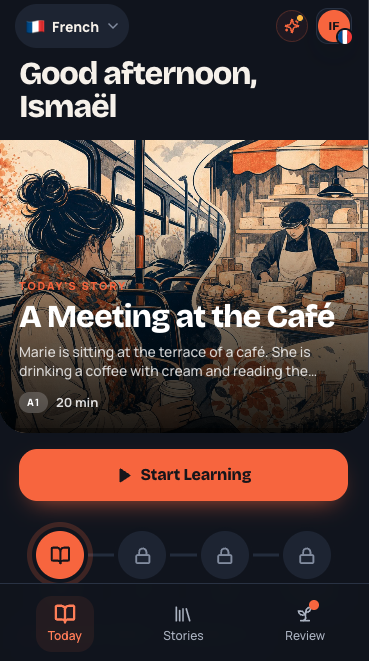
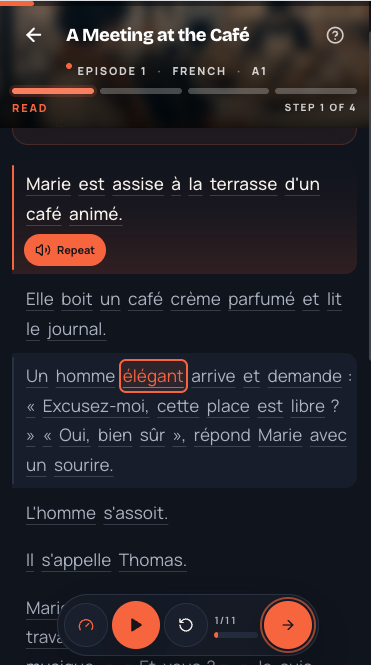
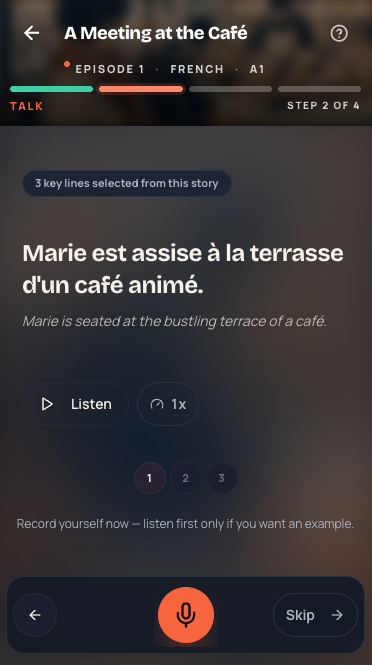
Bilingual narratives with narration — parallel text plus output.
Short A1–B2 paragraphs with line-by-line translation.
Interactive demo of tap-to-gloss on real passages.
How reading, listening, and speaking share one story arc.
Learn the method
Our comparisons draw on published research about reading in context, learning words through stories, and building a daily habit — with sources linked below.
Answers
MeloLingua is a strong Beelinguapp alternative for learners who like bilingual stories but also want story narration, vocabulary help, and guided speaking practice.
Beelinguapp focuses on parallel-text reading. MeloLingua focuses on full story sessions that combine reading, listening, vocabulary, and pronunciation practice.
MeloLingua gives learners fast meaning support through tap-to-translate vocabulary and bilingual scaffolding while keeping the main experience inside one story arc.
Choose an app that lets you hear narrator lines and repeat full sentences. MeloLingua builds those pronunciation reps into the story session.
Yes. Use Beelinguapp for casual parallel reading and MeloLingua for a daily loop that adds listening and speaking practice.
MeloLingua is built for learners who want daily exposure to compound into comprehension, vocabulary recall, and clearer spoken sentences.