Spanish Reading Passages: Free A1–B2 Library
Spanish reading passages are short, CEFR-graded readings for focused practice. Browse the A1–B2 passage catalog here, then open each passage on its canonical reading page for the full text, vocabulary, translation, audio where available, and comprehension support.
Use this page to discover a passage by level, topic, or length. For a quick Spanish paragraph or text, use Spanish texts to read; for a repeatable daily routine, use Spanish reading practice; for scored questions and worksheets, use Spanish reading exercises.
Reviewed by Francisco· Updated
Passage directory
Choose a Spanish reading passage
Choose your next read
Spanish text library
Filter the complete library by level, real-life topic, or length. Every text includes an English translation, vocabulary support, and comprehension questions.
45 texts shown.
Beginner
20 texts
La mañana de María
María se despierta a las siete.
Read La mañana de MaríaLos colores del jardín
El jardín de Rosa tiene muchas flores.
Read Los colores del jardínEn el supermercado
Leo entra en el supermercado con una lista.
Read En el supermercadoLa casa de Ana
Ana vive en una casa pequeña con su familia.
Read La casa de AnaLa mochila de Nico
Nico tiene clase de dibujo hoy.
Read La mochila de NicoEl autobús correcto
Sara espera en una parada de autobús.
Read El autobús correctoMi primer carné de biblioteca
Inés visita la biblioteca del barrio.
Read Mi primer carné de bibliotecaUn café y una tostada
Daniel entra en un café pequeño.
Read Un café y una tostadaEn la farmacia
Clara entra en una farmacia.
Read En la farmaciaPlanes para un día de lluvia
Marta y Luis quieren jugar al tenis.
Read Planes para un día de lluviaEl perro en la plaza
Tomás ve un perro solo en la plaza.
Read El perro en la plazaPan para la cena
Elena entra en la panadería del barrio.
Read Pan para la cenaUna compañera nueva
Hoy llega una alumna nueva a la clase.
Read Una compañera nuevaPicnic en el parque
Irene y Joel preparan un picnic.
Read Picnic en el parqueUna habitación tranquila
Raúl llega a un hotel pequeño.
Read Una habitación tranquilaEl cumpleaños de Lucía
Hoy Lucía cumple dieciocho años.
Read El cumpleaños de LucíaFruta en el mercado
Nora visita el mercado de la plaza.
Read Fruta en el mercadoUn billete a Toledo
Álex quiere viajar a Toledo en tren.
Read Un billete a ToledoUna camiseta azul
Vera busca una camiseta para el verano.
Read Una camiseta azulUna cita en la peluquería
Paula quiere cortarse el pelo el viernes.
Read Una cita en la peluqueríaElementary
20 texts
El viaje en tren
El sábado pasado tomé el tren de Madrid a Sevilla.
Read El viaje en trenLa playa en verano
El verano pasado, mi familia y yo fuimos a la playa durante una semana.
Read La playa en veranoUn día de lluvia
Ayer llovió mucho en la ciudad.
Read Un día de lluviaUna cena en Barcelona
Ayer por la noche, Pablo y Ana entraron en un restaurante cerca de Las Ramblas.
Read Una cena en BarcelonaCambiar una chaqueta
Ayer compré una chaqueta azul en una tienda del centro.
Read Cambiar una chaquetaUna cita en el centro de salud
Desde ayer, Marta tiene dolor de garganta y mucha tos.
Read Una cita en el centro de saludBuscamos piso compartido
Lucía y Omar buscan un piso para compartir cerca de la universidad.
Read Buscamos piso compartidoUn curso de cocina
Diego quiere aprender a preparar platos mexicanos.
Read Un curso de cocinaUn cumpleaños sorpresa
Nora cumple treinta años el próximo sábado.
Read Un cumpleaños sorpresaPerdidos en el museo
Elena y Tomás visitan un museo de ciencias muy grande.
Read Perdidos en el museoPrimer día en la oficina
Hoy es el primer día de Leandro en una oficina nueva.
Read Primer día en la oficinaEl huerto del barrio
En el barrio de Alba hay un pequeño huerto comunitario.
Read El huerto del barrioUn perro encontrado
Ayer por la tarde, Raúl encontró un perro cerca del parque.
Read Un perro encontradoExcursión a la montaña
El domingo, Paula y Nico hicieron una excursión a la montaña.
Read Excursión a la montañaCambiar una reserva de hotel
Clara tiene una reserva de hotel para el viernes y el sábado.
Read Cambiar una reserva de hotelUn libro devuelto con retraso
Sofía encuentra un libro de la biblioteca debajo de su cama.
Read Un libro devuelto con retrasoCompras para una receta
Amir quiere cocinar una sopa de verduras para cuatro personas.
Read Compras para una recetaUna conversación sobre el ruido
Desde hace una semana, Julia oye música alta por la noche.
Read Una conversación sobre el ruidoLimpieza de la playa
El sábado, un grupo de voluntarios limpió una playa pequeña.
Read Limpieza de la playaReparar la bicicleta
Esta mañana la bicicleta de Eva hacía un ruido extraño.
Read Reparar la bicicletaIntermediate
3 texts
El mercado de san miguel
La primera vez que visité el Mercado de San Miguel en Madrid, me sorprendió la cantidad de colores y aromas que llenaban el espacio.
Read El mercado de san miguelUn café con historia
En una novela ambientada en Buenos Aires aparece el Café de los Poetas, un local ficticio que parece detenido en el tiempo.
Read Un café con historiaUna decisión importante
Cuando Laura recibió una oferta de trabajo en Valencia, no supo qué responder.
Read Una decisión importanteUpper-intermediate
2 texts
La tradición del flamenco
Es posible que no exista otra forma artística que represente el alma de Andalucía con tanta intensidad como el flamenco.
Read La tradición del flamencoEl futuro de la agricultura
En las últimas décadas, la agricultura española ha experimentado una transformación silenciosa pero profunda.
Read El futuro de la agriculturaNo text matches those filters.
Try another topic or clear the search.
Printable Spanish reading comprehension worksheets
Print five A1–B2 passages with comprehension questions and vocabulary support for classrooms, homework, or offline study.
Print free worksheets →Continue this skill in MeloLingua
Turn Spanish reading passages into listening and speaking practice
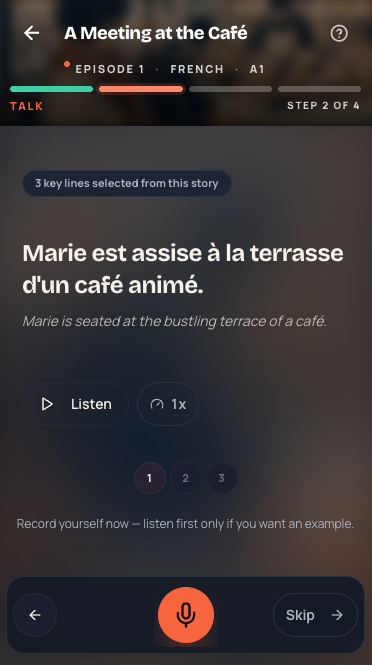
MeloLingua keeps the text, narration, meaning support, and pronunciation work inside the same story. Read for meaning first, replay the lines, then speak selected sentences while the scene is still fresh.
Best fit
Learners who want connected reading, listening, and lower-pressure speaking in one short session.
Honest limitation
MeloLingua does not replace live conversation with a tutor or partner.
13 app languages · Web + Android · Free tier
More Spanish reading paths
Explore Spanish reading passages, short stories, in-context translation, and a step-by-step writing guide.
Quick read
Spanish texts to read
Choose one standalone paragraph or text by level, topic, or length.
Daily practice
Spanish reading practice
Use a repeatable read, check, reread, and listen routine.
Test comprehension
Spanish reading exercises
Answer questions, check explanations, or print a worksheet.
B1–B2 only
Intermediate Spanish reading
Skip the beginner material and work with denser B1–B2 texts.
Answers
Frequently asked questions
Q01Where can I find free Spanish reading passages?
Where can I find free Spanish reading passages?
This directory lists free Spanish reading passages from A1 through B2. Open a passage for the complete text, vocabulary support, English translation, comprehension prompts, and audio where available. No signup is required.
Q02Which Spanish reading passage level should I choose?
Which Spanish reading passage level should I choose?
Choose A1 for short present-tense scenes, A2 for simple past narration, B1 for longer connected paragraphs, and B2 for opinion or cultural texts. Step down one band if the main idea is unclear without frequent translation.
Q03Can I print Spanish reading comprehension worksheets?
Can I print Spanish reading comprehension worksheets?
Yes. Open the Spanish reading exercises page and use the Print free worksheets button to print five A1–B2 passages with comprehension questions and vocabulary support. The online version keeps the answer explanations and optional English translation available for review.
Q04How do Spanish reading passages differ from stories?
How do Spanish reading passages differ from stories?
Reading passages are shorter, topical texts designed for vocabulary practice and comprehension drills. Stories add narrative arcs, characters, and emotional hooks. Both are useful — passages build analytical reading speed; stories build engagement and natural sentence flow.
Q05What is the difference between passages, texts, practice, and exercises?
What is the difference between passages, texts, practice, and exercises?
Use this passage directory to browse. Use Spanish texts to read when you want one quick text, Spanish reading practice for a repeatable study routine, and Spanish reading exercises when you want questions, answers, or a printable worksheet.
Read Spanish passages every day in MeloLingua
Melolingua delivers fresh Spanish reading passages matched to your level — native audio, tap-to-translate vocabulary, and speaking practice built in.