98%
of words on a page you need to know before reading feels comfortable without a dictionary
Vocabulary research (Paul Nation, 2006)
Choose MeloLingua if you want comprehension and spoken recall from complete story scenes with free web access. Choose Duolingo if you need the widest language catalog and a game-like drill habit to get started.
Duolingo is one of the best apps for starting a daily habit. MeloLingua is built for the next step: one story scene where reading, narration, vocabulary, and speaking reps stay on the same lines — on the web or in the app.
Written by our language team· Updated · How we write comparisons
Source and disclosure: MeloLingua publishes this comparison and appears in it. Product facts are checked against official sources; recommendations are editorial judgments about how each app fits a learning routine, not controlled evidence that one app produces better outcomes.
By the numbers
Reading and listening inside a story — with help when you need it — helps many people remember words better than flashcards alone.
98%
of words on a page you need to know before reading feels comfortable without a dictionary
Vocabulary research (Paul Nation, 2006)
95%
known-word coverage is a practical minimum for supported reading, but still leaves frequent unknown words
Vocabulary research (Paul Nation, 2006)
A1–B2
the current level range used for MeloLingua story sessions and public graded readers
MeloLingua product fact · verified August 13, 2026
Side by side
This table compares how you actually practice — not brand hype. We say where Duolingo still wins; see the verdict cards below.
MeloLingua vs Duolingo — side-by-side comparison
| Topic | MeloLingua | Duolingo |
|---|---|---|
| Core method | Short graded stories with narration and speaking checkpoints on the same text | Gamified translation and drill lessons in a skill tree |
| Best for | Turning daily minutes into comprehension, listening stamina, and spoken recall | Starting a low-friction daily habit across many languages |
| Practice unit | One story scene — paragraphs and full sentences with plot context | Short prompts and isolated sentence tiles |
| Read + listen + speak | Same lines carry all three modes in one session | Skills split across separate lesson types; Stories tab is optional |
| Speaking practice | Listen and repeat aloud drills tied to narrator lines you already understood | Speech checks vary by lesson, language, and subscription tier |
| Web access | Free graded stories to read on melolingua.com (no signup); free web app at stories.melolingua.com after a quick sign-up | Web and app available; habit loop is app-first for most learners |
| Pricing | Free on web and Android; core story loop at no cost | Free tier with ads; Duolingo Super subscription for ad-free and extra features |
| Language depth | 13 app languages; the deepest free web libraries are Spanish, French, German, and Italian, currently A1–B2 | 40+ languages; depth and features vary by language and course |
| Motivation loop | Narrative progress, finished arcs, and skill milestones | Streaks, XP, leagues, and badges |
| Best next step | Use when drills feel too shallow or speech still freezes | Use when you need habit momentum or language sampling first |
Making the switch
The switch is not about studying longer — it is about replacing fragmented prompts with connected input you can hear, understand, and say back. Most learners who combine both apps use Duolingo for habit maintenance and MeloLingua for the block that actually moves comprehension and speech.
1
Start from a short story scene instead of a bare prompt. You should recognize 85–95% of words on a first read at your level — enough friction to learn, enough flow to finish.
2
Tap words only when blocked, then continue the narrative. Duolingo often front-loads translation; story practice keeps glosses inside the scene so grammar patterns repeat naturally.
3
Listen to the same lines while the scene is still fresh. Connected listening builds stamina for real speech speed — not just recognizing isolated words in drills.
4
Repeat story sentences with guided pronunciation feedback — full lines you understood, not disconnected phrases from a tile bank.
Why the page exists
For serious learners, the useful question is which app converts attention into durable comprehension and usable speech. Gamification can start a habit; story sessions supply the input volume that makes words stick in conversation.
Input density
Story sessions carry repeated names, places, motives, and grammar patterns across multiple lines. One 10-minute scene often exposes more connected syntax than a chain of isolated drill tiles.
Output transfer
Repeating a line you understood is closer to real communication than reciting an isolated tile. MeloLingua ties shadow-and-speak reps to the narrator audio you just heard on the same text.
Motivation
Finished story arcs give learners a reason to return without making streak optics the main event. You still can keep a Duolingo streak — but narrative pull carries the session that builds fluency.
What Duolingo is
Duolingo is a freemium language app built around short translation exercises, streaks, leagues, and XP. The default loop is a completed lesson of isolated prompts — tap the right tile, earn points, keep the streak. Duolingo also offers Stories and speaking exercises in some languages, but they sit beside your main lesson sequence rather than replacing it as one connected scene with read-listen-speak checkpoints on the same lines.
Real situations
These are realistic learner situations — not every switch means canceling your current app.
That usually means you built recognition without enough connected reading and speaking. Swap one Duolingo session per day for a MeloLingua story: read a scene, hear native narration, repeat full lines aloud. Aim to know about 85–95% of words on a first read — enough to learn, enough to finish.
Try graded Spanish texts →Keep the streak if it motivates you — then spend the main block on story practice. A practical split: 5 minutes of Duolingo review, 10 minutes of MeloLingua (read, listen, speak on the same scene). Stories supply the reading and listening volume that makes words usable in speech.
Open Spanish stories →Story-first apps center narrative arcs where vocabulary recurs across scenes — not a separate Stories tab you open once a week. MeloLingua packages reading, native audio, tap-to-translate glosses, and speaking reps in one daily session instead of splitting skills across trees.
Read Duolingo alternatives roundup →Many learners hit a Duolingo plateau when prompts repeat without new connected input. Move your main study block to graded stories at your CEFR level: Spanish A2 stories if drills feel easy but real speech still blurs. Story sessions recycle grammar in plot context — closer to how words appear in conversation.
Spanish reading practice →Research note: Words you meet inside a story tend to stick better than words on flashcards alone — research often puts the advantage at 30–40% (see our 2026 story learning stats for details). Comfortable reading usually means knowing about 98% of words on the page. Duolingo is great for building a daily habit; story sessions give you connected reading and listening on the same lines — then speaking practice while the scene is still fresh.
Who should pick what
MeloLingua after the habit is formed: A complete story segment gives those minutes connected input, meaning, and output — read a scene, hear it, speak it back — instead of another tap sequence with no plot.
Duolingo: Duolingo still wins when breadth matters more than depth in a specific learning loop — sampling many languages before you commit to one.
MeloLingua: Speaking reps sit after story comprehension on the same sentences, so pronunciation attaches to meaning — not disconnected phrase tiles.
Both (different strengths): Duolingo's free tier covers drills with ads. MeloLingua offers free graded stories on the web with no signup and a free Android app for audio and speaking reps.
MeloLingua for the main session: Plateaus often mean not enough connected input volume. Story sessions recycle vocabulary in narrative context — closer to real speech patterns than repeating drill formats.
Duolingo first, then MeloLingua: Duolingo lowers the activation energy to start. Once the habit exists, shift the serious block to story practice for listening and speaking transfer.
Related guides
If Duolingo is close but not quite right, these guides cover the next apps people usually try.
Compare seven free and paid options by the skill gap you want to solve.
Return to the full comparison guide — Duolingo, LingQ, Babbel, and every alternative guide.
Free A1–B2 paragraphs — the story loop in browser, no signup.
Short narratives with story narration after you leave drill apps.
Try MeloLingua
Open a graded passage, hear the story narration, and move from reading to speaking on real A1–B2 content. These are current product screens, not concept artwork.
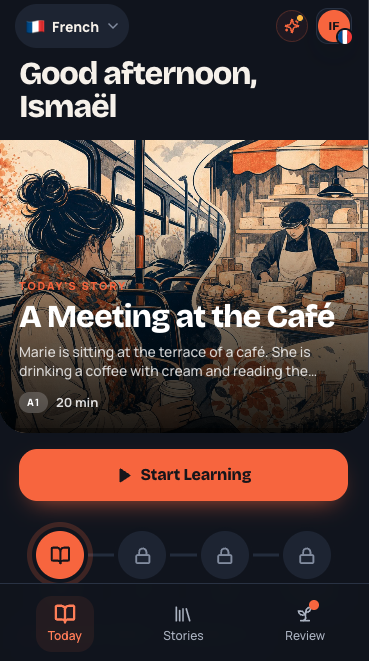
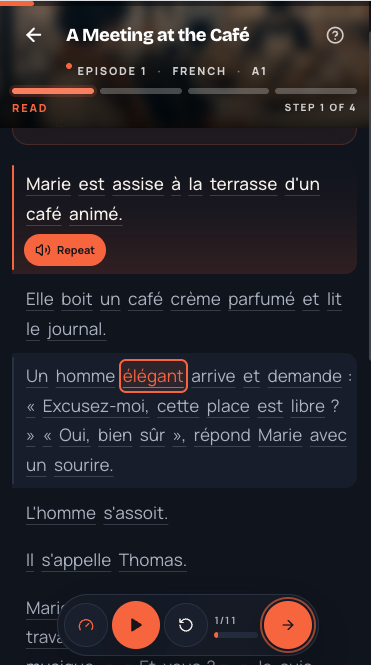
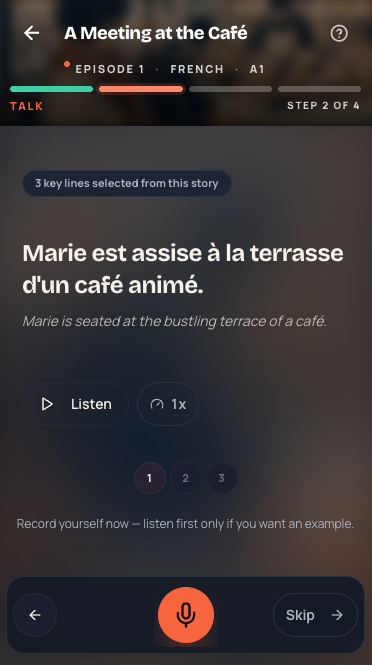
Graded A1–B2 library — the natural next step from Duolingo drills.
10 free passages with tap-to-translate vocabulary.
Daily sessions with audio, glosses, and speaking reps.
How the four-part story loop works end to end.
Learn the method
Our comparisons draw on published research about reading in context, learning words through stories, and building a daily habit — with sources linked below.
Answers
MeloLingua keeps read, listen, and speak on the same story scene — instead of isolated gamified drills. Duolingo focuses on short exercises, streaks, and skill trees. MeloLingua is free on the web (no signup) and on Android for graded stories with narration, tap-to-translate, and guided speaking reps in one session.
Yes — especially if Duolingo helped you build a habit but you now want more listening comprehension, story context, and speaking practice from full sentences. MeloLingua fits learners searching for apps like Duolingo with stories where narrative is the main path, not a side feature.
Yes. A practical split: 5 minutes of Duolingo to keep your streak, then 10 minutes of MeloLingua for the story session that combines reading, listening, vocabulary, and speaking. Duolingo maintains the habit; story practice supplies the connected input volume that builds conversational recall.
MeloLingua is better if you want to repeat story sentences after hearing the narration on the same lines. Duolingo includes pronunciation prompts in some lessons, but speaking is not the center of every unit and varies by language. Listening and repeating aloud on understood text gives you more connected speaking practice.
Both offer free tiers. Duolingo's free version includes ads and optional Duolingo Super for ad-free practice and extra features. MeloLingua offers free graded stories on the web with no signup, plus a free Android app for audio and pronunciation practice — no subscription required for the core story loop.
No. Duolingo Stories are a separate feature inside Duolingo — short narratives beside the main drill path. MeloLingua is built around one daily story session where reading, narration, glosses, and speaking checkpoints happen on the same scene from start to finish.
Prioritize comprehensible input, listening stamina, and connected-speech practice. Graded stories are a practical bridge because they keep meaning, audio, and output in the same session. Nation's research suggests reading comfortably requires knowing roughly 98% of words on a page — pick stories at your CEFR level.
Duolingo lowers the barrier on day one with gamified prompts. Once you have a daily habit, MeloLingua's graded Spanish stories (currently A1–B2) add listening and speaking on full sentences. Many learners use Duolingo for habit-building and add story practice when they want longer connected scenes.
MeloLingua is built for learners who want daily exposure to compound into comprehension, vocabulary recall, and clearer spoken sentences.