98%
of words on a page you need to know before reading feels comfortable without a dictionary
Vocabulary research (Paul Nation, 2006)
Choose MeloLingua if scripted dialogs feel too fragmented. Choose Babbel if you want a course-like sequence and grammar-forward lesson rhythm.
Babbel offers tidy lesson progression. MeloLingua is for learners who want grammar and vocabulary to emerge from stories, then become listening and speaking practice in the same session.
Written by our language team· Updated · How we write comparisons
Source and disclosure: MeloLingua publishes this comparison and appears in it. Product facts are checked against official sources; recommendations are editorial judgments about how each app fits a learning routine, not controlled evidence that one app produces better outcomes.
By the numbers
Reading and listening inside a story — with help when you need it — helps many people remember words better than flashcards alone.
98%
of words on a page you need to know before reading feels comfortable without a dictionary
Vocabulary research (Paul Nation, 2006)
95%
known-word coverage is a practical minimum for supported reading, but still leaves frequent unknown words
Vocabulary research (Paul Nation, 2006)
A1–B2
the current level range used for MeloLingua story sessions and public graded readers
MeloLingua product fact · verified August 13, 2026
Side by side
This table compares how you actually practice — not brand hype. We say where Babbel still wins; see the verdict cards below.
MeloLingua vs Babbel — side-by-side comparison
| Topic | MeloLingua | Babbel |
|---|---|---|
| Lesson spine | Story arcs with comprehension checkpoints | Modular grammar-forward lesson stacks |
| Grammar feel | Usage-first patterns inside scenes | Explicit lesson sequencing and dialogs |
| Listening practice | Narration synced to story lines | Recorded prompts tied to scripts |
| Speaking practice | Listen and repeat aloud on story lines | Dialog rehearsal varies by lesson |
| Best fit | Immersion-first learners craving narratives | Routine learners wanting predictable course milestones |
Course to context
The point is not to remove structure. It is to make structure serve comprehension and speech instead of standing alone.
1
The session starts with a reason to understand what happens next.
2
Patterns repeat naturally across the paragraph and dialog.
3
Audio carries the full sentence, not just a demonstration prompt.
4
Output practice recycles the sentence while the scene is still memorable.
Original angle
A story-first session gives grammar a situation, which makes the learning target easier to retrieve later.
Context
Requests, refusals, and descriptions land better when a character needs them.
Memory
Words are easier to recall when attached to place, motive, and consequence.
Speech
Repeating a story line trains rhythm and meaning at the same time.
What Babbel is
Babbel is a subscription app built around bite-sized course lessons, scripted dialogs, and explicit grammar explanations across roughly fourteen languages. Each lesson is self-contained — but they don't connect as an extended story arc with integrated speaking checkpoints.
Real situations
These are realistic learner situations — not every switch means canceling your current app.
Recognition without connected output is a common plateau. Add a MeloLingua story session: read a graded scene, hear the same lines, repeat aloud. Target 85–95% known words on first read — Nation's coverage band for productive reading.
Open A1–B2 Spanish texts →Keep Babbel for explicit review twice a week. Use MeloLingua on other days for story mileage. Comprehensible-input research treats extensive reading and listening as the main growth engine; explicit lessons become the supplement.
Browse Spanish story library →Fragmented prompts teach forms; stories teach when forms matter. MeloLingua speaking reps attach to sentences with motive and setting — requests, refusals, and descriptions land because a character needed them.
Read Spanish stories online →Research note: Words learned in context stick better than words on isolated lists — often by 30–40%. Babbel excels at clear lesson structure and grammar explanations; MeloLingua adds story reading and listening so those forms show up in real sentences you can say aloud.
Who should pick what
Babbel: A course-style path is useful when predictability is the main need.
MeloLingua: Stories give new vocabulary motives, consequences, and repetition across context.
MeloLingua: The speaking prompt comes from a line you just understood.
Related guides
If Babbel is close but not quite right, these guides cover the next apps people usually try.
Try MeloLingua
Open a graded passage, hear the story narration, and move from reading to speaking on real A1–B2 content. These are current product screens, not concept artwork.
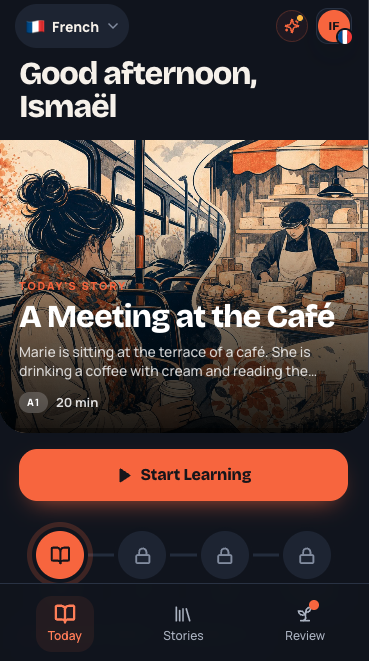
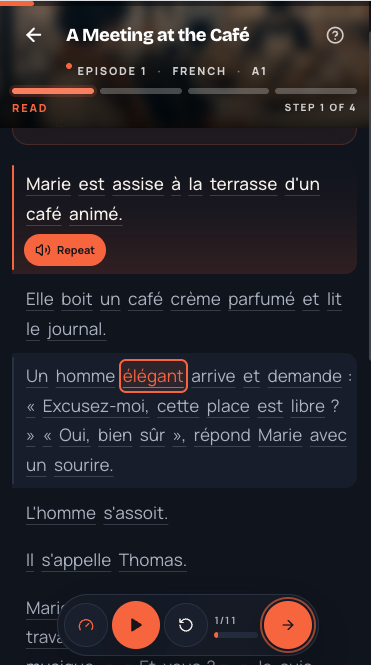
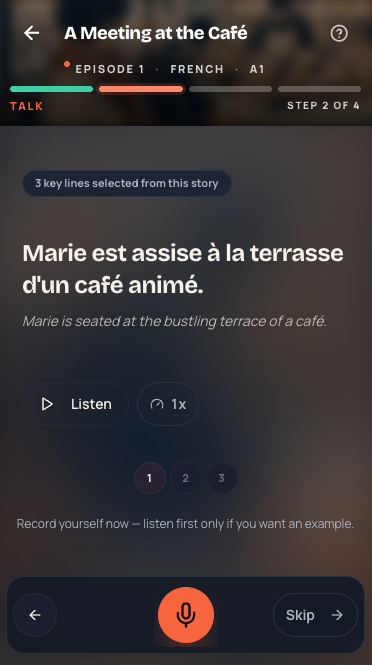
Story-first immersion when lesson tiles feel too fragmented.
Narrative arcs with grammar in context, not isolated grids.
Structured CEFR input between longer story sessions.
Usage-first grammar inside graded story sessions.
Learn the method
Our comparisons draw on published research about reading in context, learning words through stories, and building a daily habit — with sources linked below.
Answers
MeloLingua is a strong Babbel alternative if you want vocabulary, grammar, listening, and speaking to happen inside short story sessions.
Babbel organizes course-style lessons and scripted dialogs. MeloLingua organizes story arcs where grammar and vocabulary appear in context, then become listening and speaking practice.
MeloLingua emphasizes usage-first grammar inside stories. That makes it better for learners who want context and repetition rather than isolated conjugation grids.
MeloLingua is built around shadow-and-speak drills that follow narrated story lines, so pronunciation practice stays connected to meaning.
Yes. Babbel can supply explicit course structure while MeloLingua supplies story-based input and speaking reps.
MeloLingua is built for learners who want daily exposure to compound into comprehension, vocabulary recall, and clearer spoken sentences.
Review these words right before you would forget them