La cola en el banco
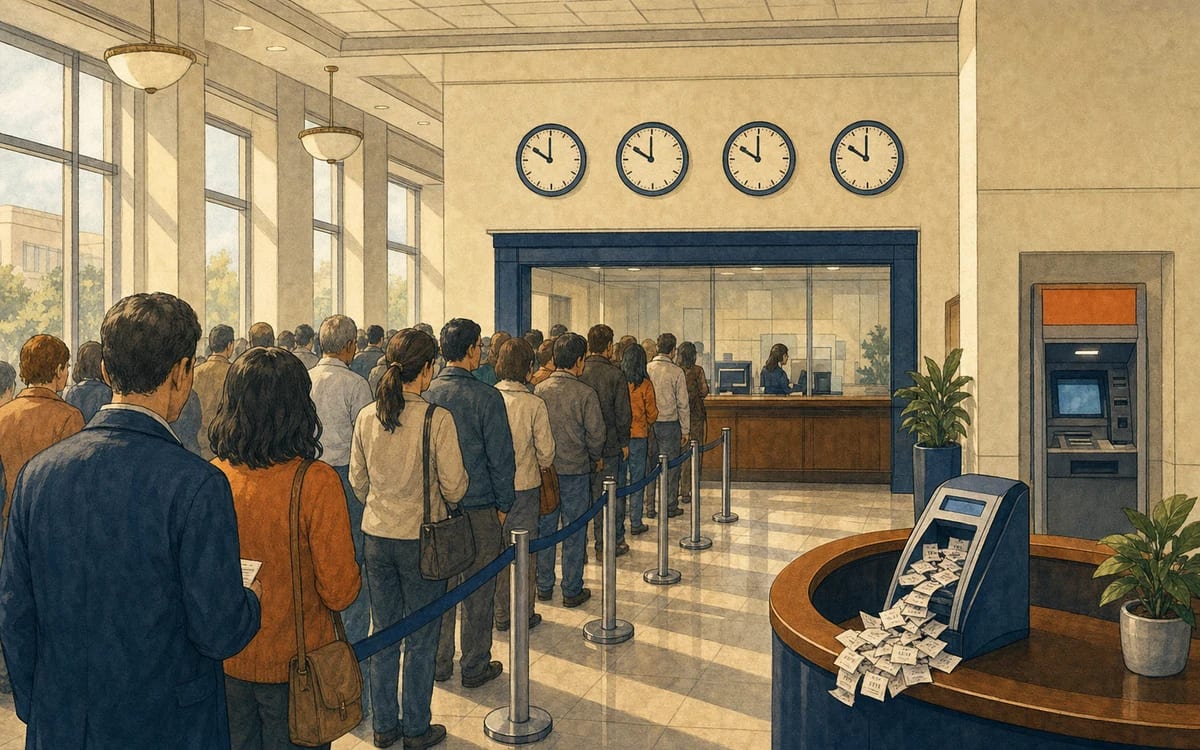
Ana placed herself at the end of the line and sighed. It was ten in the morning and the bank was full.
What you'll learn
- Bilingual graded story
- English translation
- 7 useful words
- 5 comprehension questions
Warm-up vocabulary
Preview 2 optional words before reading
Your Spanish story
Tap highlighted words when you need help
Ana se colocó al final de la y . Eran las diez de la mañana y el banco estaba lleno.
Ana placed herself at the end of the line and sighed. It was ten in the morning and the bank was full.
Solo había una abierta y la señora del número 34 discutía el cambio de su con la cajera.
There was only one teller window open and the lady with number 34 was arguing about her pension change with the teller.
La se hizo más larga cuando la máquina de números y el recepcionista tuvo que reiniciarla.
The wait grew longer when the ticket machine jammed and the receptionist had to restart it.
Ana miró el reloj y calculó que llegaría tarde a su del médico. «Qué mañana», .
Ana looked at her watch and calculated that she would be late for her doctor's appointment. 'What a morning,' she murmured.
Detrás de ella, un hombre mayor que antes el banco abría media hora antes y que nunca había tantas colas.
Behind her, an elderly man commented that before, the bank opened half an hour earlier and that there were never so many lines.
Ana asintió sin mirarlo. Pensó en llamar al médico para avisar del , pero el móvil le indicaba .
Ana nodded without looking at him. She thought about calling the doctor to let them know about the delay, but her phone indicated a low battery.
Un joven con auriculares en voz alta de que el banco necesitaba más , y varias personas asintieron.
A young man with headphones complained loudly that the bank needed more staff, and several people nodded.
Ana ya de la cola cuando oyó que una señora mayor, que esperaba unos puestos más atrás, un número en su móvil y empezó a hablar en voz baja.
Ana was about to leave the line when she heard an elderly woman a few places behind her dial a number on her phone and start speaking quietly.
«, hija, estoy en la cola para sacar el dinero. que vengas corriendo», dijo la señora con una voz cansada pero tranquila.
'Don't worry, dear, I'm in line to withdraw the money. You don't need to rush over,' the woman said, tired but calm.
Ana sintió un . La señora colgó y Ana, en lugar de salirse, su sitio en la cola.
Ana felt a lump in her throat. The lady hung up and Ana, instead of leaving, offered her spot in line.
Vocabulary recap
Reading Comprehension Exercise
B1 Spanish Reading Comprehension Exercises
1. Where is Ana waiting at the beginning of the story?
Correct: In a bank queue
Ana placed herself at the end of the bank queue, which was full.
2. Why does the wait get longer?
Correct: Because the number machine jammed
The ticket machine jammed and the receptionist had to restart it.
3. What problem does Ana have besides the queue?
Correct: Her phone battery is low and she'll be late for the doctor
Ana calculates she'll be late for her doctor's appointment and her phone battery is low.
4. What does the elderly woman tell her daughter on the phone?
Correct: She is waiting to withdraw the money and her daughter need not rush over.
The woman is still in the queue to withdraw the money. She reassures her daughter that she need not hurry to the bank.
5. What does Ana do at the end of the story?
Correct: Offers her place in line to the elderly lady
Ana, hearing the conversation, feels empathy and offers her place in line to the elderly lady.
Nailed the quiz? Start your own story in MeloLingua →
Mini-lesson complete
You understood 5 of 5 questions.
That is 221 real Spanish words read in context.
- ✓ 221 words read
- 7 new expressions
- 2 grammar patterns
- B1 level unlocked
Ready for tomorrow’s story?Hear it, shadow the narrator, and lock these words into memory in MeloLingua.
Start learning with storiesOne story. The whole practice loop.
Reading this story for free is just the first rep. The MeloLingua app turns the same story into a full practice loop — understand every word, speak it back, build sentences, and keep stories coming that match what you actually care about.
| What you get | FreeThis story | Full loopMeloLingua app |
|---|---|---|
| Understand every sentence instantly | Bilingual reader, tap to translate | Interactive reader with word-by-word explanations |
| Know exactly why each word works | Basic translation in context | Translation, grammar, conjugation & usage examples |
| Train your ear with native audio | Not included | Listen, follow along, and shadow the narrator |
| Speak like a native while reading | Read aloud on your own | Real-time pronunciation feedback |
| Turn what you read into what you can say | Not included | Build sentences from the story you just read |
| Never forget today's vocabulary | In-story glossary + comprehension quiz | Flashcards & spaced review from story lines |
| Read stories about your real life | Not included | Stories matched to your level and interests |
| Feel yourself improve every day | Not included | Streaks, goals, and your full learning history |
| Result | Enjoy a great story | Actually speak with confidence |
Understand every sentence instantly
Know exactly why each word works
Train your ear with native audio
Speak like a native while reading
Turn what you read into what you can say
Never forget today's vocabulary
Read stories about your real life
Feel yourself improve every day
Result
Make stories aboutyour life
Most language apps hand everyone the same content. MeloLingua lets you create stories around the things you actually enjoy — so staying consistent stops feeling like homework.
- “I love space and cooking”Your story
A chef opens the first restaurant on Mars.
- “I like football and history”Your story
A young striker time-travels to play the legendary teams.
- “I enjoy surfing and travel”Your story
A surfer hunts secret waves across the world.
- “I like Brazilian Jiu-Jitsu and sci-fi”Your story
An astronaut enters the first intergalactic grappling tournament.
Read it. Listen to it. Speak it back. The more it sounds likeyour world, the easier it is to keep going.
Generate your first storyMake it yours
Your next Spanish story is one tap away
Turn today's read into a daily habit — personalized scenes, native audio, tap-to-translate vocabulary, and speaking drills matched to what you just understood.
Keep reading on-site

El puente de septiembre
A planned beach weekend in Cádiz turns into an unexpected exploration of a hidden cove when rain forces two friends off the sand.
Read story →
La bandeja equivocada
At a Granada bakery-café, Lucía’s pastry order disappears just before an important studio meeting.
Read story →
La carta de reclamación
Sofia must draft a formal complaint letter for a dissatisfied client but struggles to balance firmness and politeness in a Valencia office.
Read story →