Il Corso di Cucina
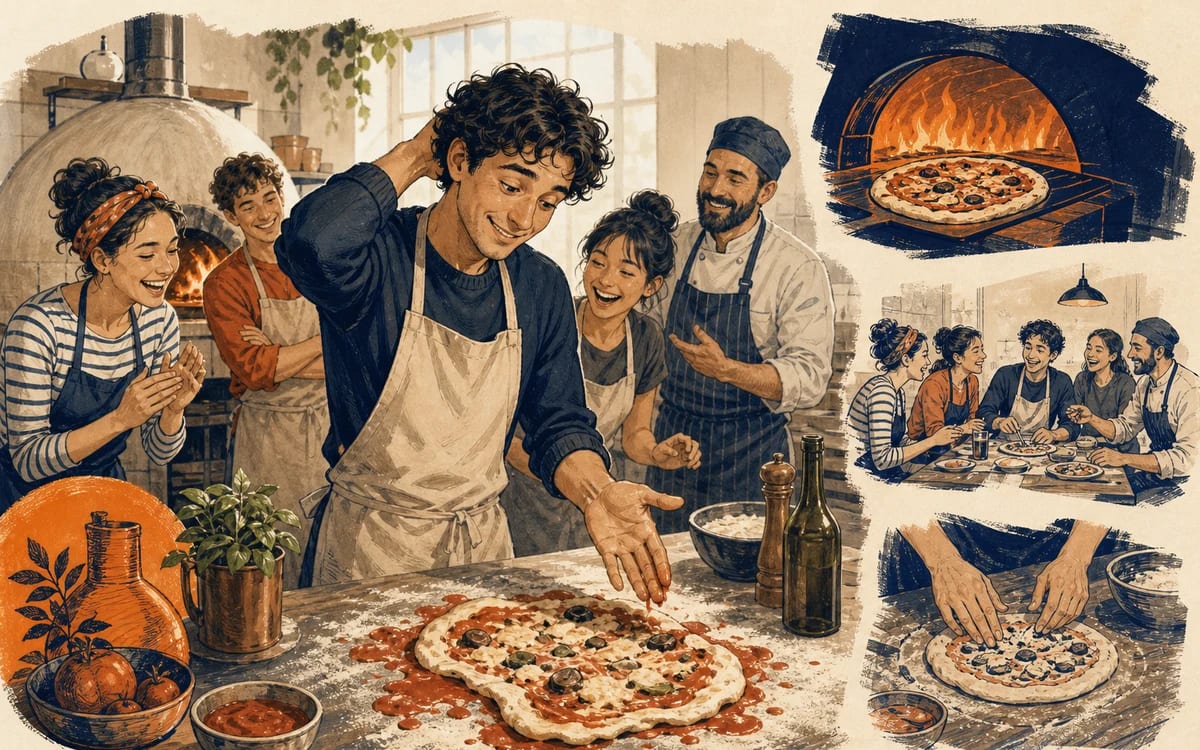
Marco signed up for a cooking class because he wanted to learn how to make fresh pasta.
What you'll learn
- Bilingual graded story
- Native narration
- 7 useful words
- 6 comprehension questions
Then shadow
Borrow the narrator’s rhythm
Pause after this line and repeat it aloud without translating. Aim for three clean repetitions.
1Listen first
Hear the whole story
Native Italian narration of this exact text. Keep the transcript visible on the first pass.
Playback speed: Natural
2Then shadow
Marco si è iscritto a un corso di cucina perché voleva imparare a preparare la pasta fresca.Warm-up vocabulary
Preview 1 optional words before reading
Your Italian story
Read along with the narration, and tap any highlighted word for its meaning
Marco a un corso di cucina perché voleva imparare a preparare la .
Marco signed up for a cooking class because he wanted to learn how to make fresh pasta.
La lezione si teneva in una piccola scuola vicino al mercato, con le finestre aperte al profumo della città.
The lesson was held in a small school near the market, with windows open to the city's aromas.
Quando è entrato, il profumo di basilico e pomodoro riempiva la stanza, come un abbraccio caldo.
When he entered, the smell of basil and tomato filled the room, like a warm embrace.
L'insegnante ha mostrato come mescolare e uova, poi ogni studente ha provato da solo, con mani tremanti.
The teacher demonstrated how to mix flour and eggs, then each student tried on their own, with trembling hands.
Marco era un po' e ha messo troppa farina sul tavolo, creando una piccola nuvola bianca.
Marco was a bit clumsy and spilled too much flour on the table, creating a small white cloud.
Una signora accanto a lui ha riso gentilmente e gli ha dato un prezioso.
A lady next to him laughed kindly and offered him some valuable advice.
Dopo mezz'ora, la pasta era pronta per essere tagliata, morbida e dorata. Alla fine, tutti hanno mangiato insieme, tra risate e racconti di cucina.
After half an hour, the pasta was ready to be cut, soft and golden. In the end, everyone ate together, amidst laughter and tales of cooking.
La pasta di Marco non era perfetta, ma aveva un buonissimo, come un abbraccio di sapori.
Marco's pasta wasn't perfect, but it tasted wonderful, like a hug of flavors.
Uscendo dalla scuola, ha deciso che avrebbe cucinato per i suoi amici il sabato successivo, con un sorriso di soddisfazione.
Leaving the school, he decided he would cook for his friends the following Saturday, with a satisfied smile.
Vocabulary recap
Reading Comprehension Exercise
A2 Italian Reading Comprehension Exercises
1. Why did Marco sign up for the cooking course?
Correct: To learn how to prepare fresh pasta
Marco signed up for the cooking course because he wanted to learn how to prepare fresh pasta, one of the basics of Italian cuisine.
2. Where was the cooking lesson held?
Correct: At a small school near the market
The lesson was held at a small school near the market, a perfect place to learn with fresh ingredients.
3. How did the lady next to Marco react when he made a mistake?
Correct: She gave him a valuable tip
The lady next to Marco laughed kindly and gave him a valuable tip, showing support and friendliness.
4. What was the final result of Marco's pasta?
Correct: Not perfect but very tasty
Although Marco's pasta wasn't perfect, it tasted wonderful, showing that effort matters.
5. What did Marco decide at the end of the course?
Correct: To cook for his friends
Leaving the school, Marco decided to cook for his friends the following Saturday, excited to share what he had learned.
6. Sfida: Perché la signora accanto a Marco gli dà un consiglio invece di criticarlo?
Correct: Perché sa che imparare insieme è meglio che giudicare
La signora dimostra uno spirito di collaborazione tipico dei corsi di cucina, dove ci si aiuta invece di competere.
Nailed the quiz? Start your own story in MeloLingua →
Line 1 / 9
0:00/–:––
Mini-lesson complete
You understood 6 of 6 questions.
That is 163 real Italian words read in context.
- ✓ 163 words read
- 7 new expressions
- 2 grammar patterns
- A2 level unlocked
- ○ Narration ready
- 0 shadowing reps
Ready for tomorrow’s story?Hear it, shadow the narrator, and lock these words into memory in MeloLingua.
Start learning with storiesOne story. The whole practice loop.
Reading this story for free is just the first rep. The MeloLingua app turns the same story into a full practice loop — understand every word, speak it back, build sentences, and keep stories coming that match what you actually care about.
| What you get | FreeThis story | Full loopMeloLingua app |
|---|---|---|
| Understand every sentence instantly | Bilingual reader, tap to translate | Interactive reader with word-by-word explanations |
| Know exactly why each word works | Basic translation in context | Translation, grammar, conjugation & usage examples |
| Train your ear with native audio | Studio narration — slow, normal, fast | Listen, follow along, and shadow the narrator |
| Speak like a native while reading | Read aloud on your own | Real-time pronunciation feedback |
| Turn what you read into what you can say | Not included | Build sentences from the story you just read |
| Never forget today's vocabulary | In-story glossary + comprehension quiz | Flashcards & spaced review from story lines |
| Read stories about your real life | Not included | Stories matched to your level and interests |
| Feel yourself improve every day | Not included | Streaks, goals, and your full learning history |
| Result | Enjoy a great story | Actually speak with confidence |
Understand every sentence instantly
Know exactly why each word works
Train your ear with native audio
Speak like a native while reading
Turn what you read into what you can say
Never forget today's vocabulary
Read stories about your real life
Feel yourself improve every day
Result
Make stories aboutyour life
Most language apps hand everyone the same content. MeloLingua lets you create stories around the things you actually enjoy — so staying consistent stops feeling like homework.
- “I love space and cooking”Your story
A chef opens the first restaurant on Mars.
- “I like football and history”Your story
A young striker time-travels to play the legendary teams.
- “I enjoy surfing and travel”Your story
A surfer hunts secret waves across the world.
- “I like Brazilian Jiu-Jitsu and sci-fi”Your story
An astronaut enters the first intergalactic grappling tournament.
Read it. Listen to it. Speak it back. The more it sounds likeyour world, the easier it is to keep going.
Generate your first storyMake it yours
Your next Italian story is one tap away
Turn today's read into a daily habit — personalized scenes, native audio, tap-to-translate vocabulary, and speaking drills matched to what you just understood.
Keep reading on-site

Cena alla pizzeria
Marco prenota un tavolo, chiede consigli educati alla cameriera e assapora una margherita calda senza distrarsi dal telefono.
Read story →
Domenica al parco
Matteo e Lucia camminano con Leo vicino al laghetto, condividono una mela in panchina e progettano un picnic quando il tempo regge.
Read story →
Il colloquio di lavoro
Elena walks HR through two shipped projects, answers remote-team cadence without buzzwords, and names a salary band after one composed breath.
Read story →