El Descubrimiento de Clara
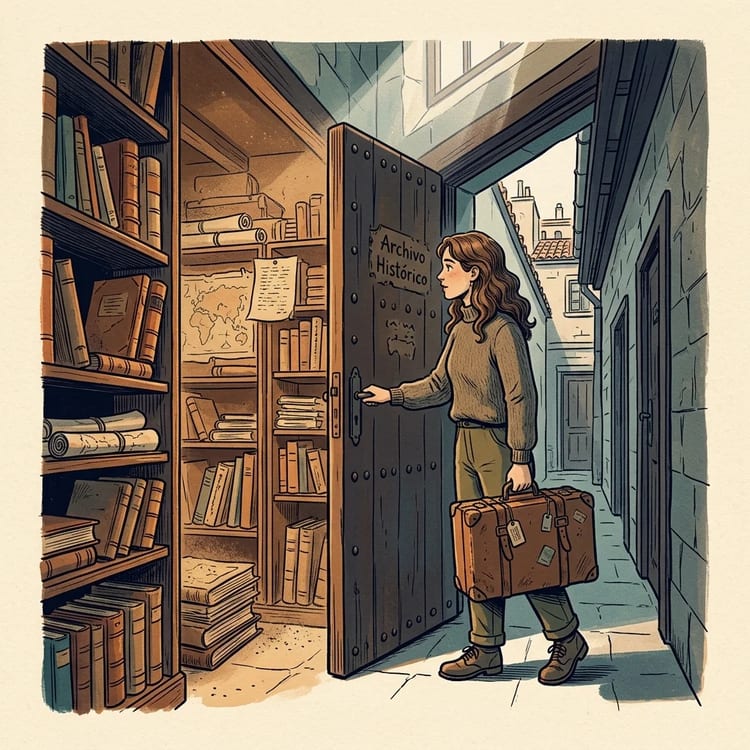
Clara arrives in Madrid to start her library job and discovers a cold, dusty archive room in the basement, where a mystery from 1954 awaits.
Today's learning
- 5-minute story
- Native narration
- 18 useful words
- 5 comprehension questions
- A2 Spanish
Pre-Reading Vocabulary
Review these key words and phrasing examples before you begin reading.
Your Spanish story — tap highlighted words when you need help
5 min readClara camina despacio por la concurrida calle de Atocha, con su pesada maleta en la mano y el ruido de Madrid en los oídos. Las persianas metálicas de las tiendas chirrían al abrirse, mientras el aroma a churros fritos y café recién hecho escapa de los pequeños bares de la esquina. El sol de la mañana empieza a brillar con fuerza, iluminando las letras doradas de Cervantes grabadas en el suelo de adoquines del céntrico Barrio de las Letras. Madrid es un laberinto dinámico lleno de coches, gente siempre activa y balcones llenos de plantas que Clara mira con curiosidad. Clara tiene veintiséis años, trabaja de archivera y llega a la capital con una mezcla de gran esperanza y un cansancio que le pesa en el alma. Su nuevo hogar es una buhardilla minúscula pero acogedora en la última planta de un edificio antiguo que huele a madera vieja. En el portal, la portera le entrega las llaves de metal y le da una cálida bienvenida con una sonrisa cansada. Clara sube las escaleras de madera, que crujen con cada paso. Desde su pequeña ventana ve la cúpula de una iglesia lejana y escucha el murmullo constante de la ciudad. Unas horas más tarde, va a la Biblioteca Histórica del barrio. La directora, la señora Vargas, la recibe en su despacho con una taza de café caliente. «El trabajo es urgente, Clara», dice con tono serio. «El sótano esconde documentos sin catalogar desde la Guerra Civil». Bajan por una escalera de caracol de piedra fría, donde la luz desaparece y el aire se vuelve helado. Al final del pasillo hay una puerta de madera maciza con un viejo cartel negro que dice «Archivo Reservado». Al abrirse, un fuerte olor a polvo golpea a Clara. Cientos de cajas de cartón llenan las estanterías de suelo a techo, cubiertas por una gruesa capa de olvido gris. «Nadie entra aquí desde hace treinta años», explica Vargas. Con el corazón acelerado, Clara camina entre las estanterías oscuras y toca el lomo frío de un archivador de madera. Cada caja esconde fragmentos de vidas pasadas. En un rincón ve un escritorio antiguo de roble cubierto por una sábana llena de telarañas. Debajo encuentra una taza de café vacía y una mancha de tinta negra. El cajón tiene una cerradura de bronce oxidada y está entreabierto, dejando una rendija. Dentro hay un sobre grueso y amarillento, atado con una cinta roja y dirigido a Clara. Clara lee con asombro: «Para Clara. La caja del sello de lacre rojo es peligrosa». La nota está fechada en mayo de 1954, el día exacto en que su abuela desapareció de Madrid.
Listen first
Hear the whole story
Native Spanish narration of this exact text. Keep the transcript visible on the first pass.
Then shadow
Borrow the narrator’s rhythm
Clara camina despacio por la concurrida calle de Atocha, con su pesada maleta en la mano y el ruido de Madrid en los oídos.Pause after this line and repeat it aloud without translating. Aim for three clean repetitions.
Show full English translation
Clara walks slowly along busy Atocha Street, carrying her heavy suitcase with the noise of Madrid in her ears. The shops’ metal shutters screech open while the smell of fried churros and freshly made coffee drifts from the small corner bars. The morning sun grows brighter, lighting Cervantes’ golden words engraved in the cobblestones of the central Literary Quarter. Madrid is a lively maze of cars, people constantly on the move, and plant-filled balconies that Clara observes with curiosity. Clara is twenty-six, works as an archivist, and arrives in the capital with both great hope and a weariness that weighs on her soul. Her new home is a tiny but welcoming attic room on the top floor of an old building that smells of aged wood. At the entrance, the concierge gives her the metal keys and welcomes her warmly with a tired smile. Clara climbs the wooden stairs, which creak with every step. From her small window she sees the dome of a distant church and hears the city’s constant murmur. A few hours later, she goes to the neighborhood’s Historical Library. The director, Mrs. Vargas, welcomes her into her office with a cup of hot coffee. “The work is urgent, Clara,” she says seriously. “The basement holds documents that have been uncatalogued since the Civil War.” They descend a cold stone spiral staircase, where the light fades and the air turns icy. At the end of the corridor stands a solid wooden door with an old black sign reading “Restricted Archive.” When it opens, a strong smell of dust hits Clara. Hundreds of cardboard boxes fill the shelves from floor to ceiling beneath a thick gray layer of neglect. “No one has entered for thirty years,” Vargas explains. Her heart racing, Clara walks between the dark shelves and touches the cold spine of a wooden filing cabinet. Every box conceals fragments of past lives. In one corner she sees an antique oak desk covered by a cobwebbed sheet. Beneath it she finds an empty coffee cup and a black ink stain. The drawer has a rusted bronze lock and sits slightly open, leaving a narrow gap. Inside is a thick yellowed envelope tied with a red ribbon and addressed to Clara. Clara reads in astonishment: “For Clara. The box with the red wax seal is dangerous.” The note is dated May 1954, the exact day her grandmother disappeared from Madrid.
Vocabulary recap
Reading Comprehension Exercise
A2 Spanish Reading Comprehension Exercises
1. What does Clara discover on Atocha Street while walking to her new home?
Correct: The noise of Madrid and shutters opening with the smell of churros and coffee
The Literary Quarter awakens with the screeching sound of its metal shutters and the scent of churros and espresso.
2. How is Clara's apartment (attic room) described?
Correct: A tiny but cozy attic room that smells of old wood
Her home is a tiny but cozy attic room on the top floor.
3. From what era are the uncatalogued documents in the library basement?
Correct: From the Spanish Civil War
Mrs. Vargas tells Clara that the basement hides documents uncatalogued since the Spanish Civil War.
4. What does Clara find when she removes the sheet from the oak desk?
Correct: An empty dry coffee cup with a black ink stain next to it
Clara finds an empty, dry coffee cup with a black ink stain at its side.
5. What warning does the thick envelope addressed to 'Clara' contain?
Correct: That the red wax-sealed box is dangerous
The letter, written with a trembling hand, warns that the box with the red wax seal is dangerous.
Nailed the quiz? Start your own story in MeloLingua →
Patterns to reuse
Describing sights and sounds around you
Clara camina despacio por la concurrida calle de Atocha, con su pesada maleta en la mano y el ruido de Madrid en los oídos.
Clara walks slowly along the bustling Atocha Street, her heavy suitcase in hand and the roar of Madrid filling her ears.
In Spanish, phrases often pile up details using 'con' to set a scene.
[Subject] + [verb] + por [place], con [object/person/feeling] en [place/part].
- con su bolso en el hombro
- con la brisa en la cara
- con la música en los oídos
Use this pattern to paint a picture of what you or someone else is experiencing while moving through a place.
Expressing how something affects you emotionally or physically
un cansancio que le pesa en el alma
an exhaustion that weighs heavy on her soul
Spanish often uses 'que le pesa en…' or similar phrases for a poetic effect.
[Noun or feeling] que le/me/te pesa en [body part/soul].
- una tristeza que le pesa en el pecho
- una alegría que me pesa en la voz
This pattern helps you emphasize the deep impact of a feeling or emotion.
Recounting what someone says with a tone
'El trabajo es urgente, Clara', dice la señora Vargas con tono serio.
‘The work is urgent, Clara,’ Mrs. Vargas says with a serious tone.
Add 'con tono [adjective]' to show the mood of speech.
[Direct quote], dice [name] con tono [adjective].
- con tono alegre
- con tono cansado
- con tono preocupado
Use this to give context and emotion when reporting what someone says.
Introducing a time reference for dramatic effect
Nadie entra aquí desde hace treinta años.
No one has set foot in here for thirty years.
Use 'desde hace' to talk about how long something hasn't happened.
[Nadie/Alguien] [verb] aquí desde hace [period of time].
- trabaja aquí desde hace una década
- vive aquí desde hace mucho tiempo
This structure helps highlight the duration of an ongoing or absent action.
Translator's Note
"The Barrio de las Letras is indeed where literary legends like Cervantes and Lope de Vega lived. But what locals love to whisper is the history of their bitter, lifelong feud. They lived just streets apart, constantly trading insults and writing biting parodies of each other's plays. Today, if you walk down Calle de las Huertas, look down: golden quotes from their masterpieces are literally paved into the cobblestones. Make sure to stop at the Convent of the Trinitarias Descalzas, where Cervantes is buried; it's a quiet oasis right in the middle of Madrid's most vibrant tapas district."
Mini-lesson complete
You understood 5 of 5 questions.
That is 442 real Spanish words read in context.
- ✓ 442 words read
- 18 new expressions
- 1 grammar pattern
- A2 level unlocked
- ○ Narration ready
- 0 shadowing reps
Ready for tomorrow’s story? Hear it, shadow the narrator, and lock these words into memory in MeloLingua.
Start learning with storiesOne story. The whole practice loop.
Reading this story for free is just the first rep. The MeloLingua app turns the same story into a full practice loop — understand every word, speak it back, build sentences, and keep stories coming that match what you actually care about.
| What you get | Free This story | Full loop MeloLingua app |
|---|---|---|
| Understand every sentence instantly | Bilingual reader, tap to translate | Interactive reader with word-by-word explanations |
| Know exactly why each word works | Basic translation in context | Translation, grammar, conjugation & usage examples |
| Train your ear with native audio | Studio narration — slow, normal, fast | Listen, follow along, and shadow the narrator |
| Speak like a native while reading | Read aloud on your own | Real-time pronunciation feedback |
| Turn what you read into what you can say | Not included | Build sentences from the story you just read |
| Never forget today's vocabulary | In-story glossary + comprehension quiz | Flashcards & spaced review from story lines |
| Read stories about your real life | Not included | Stories matched to your level and interests |
| Feel yourself improve every day | Not included | Streaks, goals, and your full learning history |
| Result | Enjoy a great story | Actually speak with confidence |
Understand every sentence instantly
Know exactly why each word works
Train your ear with native audio
Speak like a native while reading
Turn what you read into what you can say
Never forget today's vocabulary
Read stories about your real life
Feel yourself improve every day
Result
Make stories about your life
Most language apps hand everyone the same content. MeloLingua lets you create stories around the things you actually enjoy — so staying consistent stops feeling like homework.
- “I love space and cooking”Your story
A chef opens the first restaurant on Mars.
- “I like football and history”Your story
A young striker time-travels to play the legendary teams.
- “I enjoy surfing and travel”Your story
A surfer hunts secret waves across the world.
- “I like Brazilian Jiu-Jitsu and sci-fi”Your story
An astronaut enters the first intergalactic grappling tournament.
Read it. Listen to it. Speak it back. The more it sounds like your world, the easier it is to keep going.
Generate your first storyMake it yours
Your next Spanish story is one tap away
Turn today's read into a daily habit — personalized scenes, native audio, tap-to-translate vocabulary, and speaking drills matched to what you just understood.
Keep reading on-site
El Viaje en Tren
Mateo embarks on a train journey to Valencia, discovering unexpected connections and the art of patience along the way.
Open story →
Fin de semana en Granada
Laura combines a squeaky suitcase, a hillside mirador, and a slow breakfast to learn Granada one staircase at a time.
Open story →
La Panadería del Sábado
Sofía goes out early for crusty bread, trades jokes with Don Ramón at the plaza bakery, and walks home through light rain with a simpler plan.
Open story →