La Notte della Lirica
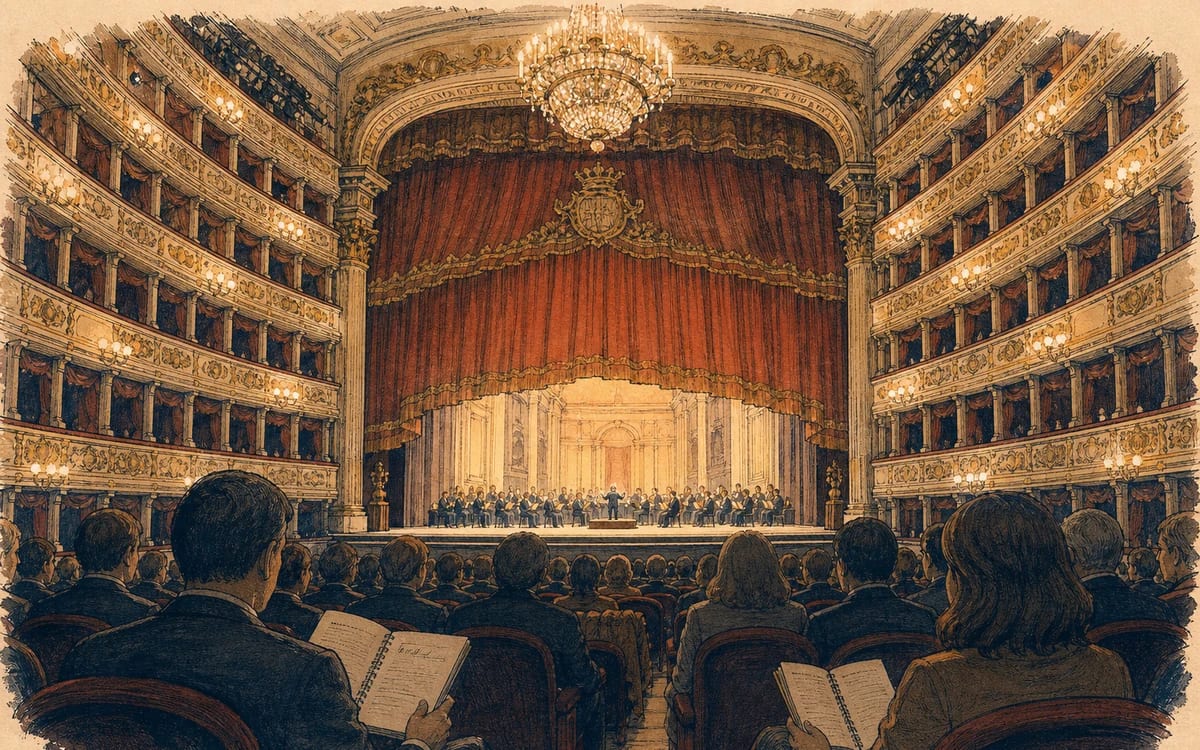
The autumn opera premiere at La Scala in Milan draws critics from all over Europe. Marco Ferrari, music critic for Corriere, is seated in the stalls, third row.
What you'll learn
- Bilingual graded story
- English translation
- 6 useful words
- 5 comprehension questions
Warm-up vocabulary
Preview 3 optional words before reading
Your Italian story
Tap highlighted words when you need help
La prima della autunnale, alla Scala di Milano, richiama critici da tutta Europa.
The autumn opera premiere at La Scala in Milan draws critics from all over Europe.
Marco Ferrari, critico musicale del Corriere, è seduto in platea, terza fila.
Marco Ferrari, music critic for Corriere, is seated in the stalls, third row.
si alza e la voce di Elena Rinaldi, il soprano, riempie la sala come un fiume in piena.
The curtain rises and the voice of Elena Rinaldi, the soprano, fills the hall like a river in flood.
Marco prende appunti. "Tecnica impeccabile, vibrato controllato, emissione potente ma mai forzata."
Marco takes notes. "Impeccable technique, controlled vibrato, powerful but never forced emission."
Eppure qualcosa lo turba. C'è una tensione nel suo sguardo che lui conosce bene.
Yet something disturbs him. There's a tension in her gaze that he knows well.
Alla fine del primo atto, il pubblico Elena dieci minuti ininterrotti.
At the end of the first act, the audience acclaims Elena for ten uninterrupted minutes.
Marco non applaude. il programma di sala, nota che manca la dedica.
Marco doesn't applaud. Peeking at the program, he notices the dedication is missing.
Di solito Elena dedica ogni spettacolo a qualcuno. Stasera, niente.
Usually Elena dedicates every performance to someone. Tonight, nothing.
Dopo lo spettacolo, Marco raggiunge . Trova Elena nel camerino, ancora in costume.
After the show, Marco reaches the backstage. He finds Elena in her dressing room, still in costume.
"Sei stata straordinaria, Elena. Ma ti conosco. Cosa c'è che non va?"
"You were extraordinary, Elena. But I know you. What's wrong?"
Elena si siede davanti allo specchio, senza guardarsi. Le mani le tremano leggermente.
Elena sits in front of the mirror, without looking at herself. Her hands tremble slightly.
"Mio padre è morto ieri," dice piano. "Cancro. Se n'è andato in tre mesi."
"My father died yesterday," she says softly. "Cancer. He was gone in three months."
Marco rimane in silenzio. Elena continua: "Mi ha insegnato tutto. Lui avrebbe voluto che cantassi."
Marco remains silent. Elena continues: "He taught me everything. He would have wanted me to sing."
"Non potevo cancellare. Il teatro era già tutto . La gente ha comprato i biglietti."
"I couldn't cancel. The theater was already sold out. People bought the tickets."
Marco chiude il taccuino. La sua sarà diversa da quella che aveva immaginato.
Marco closes his notebook. His review will be different from what he had imagined.
Reading Comprehension Exercise
B2 Italian Reading Comprehension Exercises
1. What does Marco Ferrari notice during the performance?
Correct: The soprano's technique is flawless but something is wrong in her expression
Marco notes impeccable technique but senses a tension in Elena's gaze that he knows well.
2. What does Marco notice is missing from the program?
Correct: The dedication
Marco notices the dedication is missing. Usually Elena dedicates every performance to someone, but tonight nothing.
3. What news does Elena give Marco in the dressing room?
Correct: That her father died the day before
Elena says: "My father died yesterday. Cancer. He was gone in three months."
4. Why did Elena decide to sing despite her loss?
Correct: Because the theater was already sold out and she couldn't cancel
Elena explains: "I couldn't cancel. The theater was already sold out. People bought the tickets."
5. Sfida: Perché Marco chiude il taccuino senza scrivere la recensione che aveva immaginato?
Correct: Perché la scoperta personale cambia la prospettiva critica: l'arte va oltre la tecnica
Marco capisce che la performance di Elena non era solo tecnica, ma un atto di profonda forza interiore. La critica deve tener conto dell'umano.
Nailed the quiz? Start your own story in MeloLingua →
Mini-lesson complete
You understood 5 of 5 questions.
That is 205 real Italian words read in context.
- ✓ 205 words read
- 6 new expressions
- 3 grammar patterns
- B2 level unlocked
Ready for tomorrow’s story?Hear it, shadow the narrator, and lock these words into memory in MeloLingua.
Start learning with storiesOne story. The whole practice loop.
Reading this story for free is just the first rep. The MeloLingua app turns the same story into a full practice loop — understand every word, speak it back, build sentences, and keep stories coming that match what you actually care about.
| What you get | FreeThis story | Full loopMeloLingua app |
|---|---|---|
| Understand every sentence instantly | Bilingual reader, tap to translate | Interactive reader with word-by-word explanations |
| Know exactly why each word works | Basic translation in context | Translation, grammar, conjugation & usage examples |
| Train your ear with native audio | Not included | Listen, follow along, and shadow the narrator |
| Speak like a native while reading | Read aloud on your own | Real-time pronunciation feedback |
| Turn what you read into what you can say | Not included | Build sentences from the story you just read |
| Never forget today's vocabulary | In-story glossary + comprehension quiz | Flashcards & spaced review from story lines |
| Read stories about your real life | Not included | Stories matched to your level and interests |
| Feel yourself improve every day | Not included | Streaks, goals, and your full learning history |
| Result | Enjoy a great story | Actually speak with confidence |
Understand every sentence instantly
Know exactly why each word works
Train your ear with native audio
Speak like a native while reading
Turn what you read into what you can say
Never forget today's vocabulary
Read stories about your real life
Feel yourself improve every day
Result
Make stories aboutyour life
Most language apps hand everyone the same content. MeloLingua lets you create stories around the things you actually enjoy — so staying consistent stops feeling like homework.
- “I love space and cooking”Your story
A chef opens the first restaurant on Mars.
- “I like football and history”Your story
A young striker time-travels to play the legendary teams.
- “I enjoy surfing and travel”Your story
A surfer hunts secret waves across the world.
- “I like Brazilian Jiu-Jitsu and sci-fi”Your story
An astronaut enters the first intergalactic grappling tournament.
Read it. Listen to it. Speak it back. The more it sounds likeyour world, the easier it is to keep going.
Generate your first storyMake it yours
Your next Italian story is one tap away
Turn today's read into a daily habit — personalized scenes, native audio, tap-to-translate vocabulary, and speaking drills matched to what you just understood.
Keep reading on-site

Il Condominio del Sabato
A dispute about the courtyard garden at a Roman palazzo exposes a deeper rift between old and new residents.
Read story →
Il Convegno a Milano
A young architect's presentation is upstaged by a colleague who claims her idea as his own at a design conference in Milan.
Read story →
Il Posto Vacante
A job interview at a Bologna publishing house reveals that the position may not be what the candidate was led to believe.
Read story →