Lo Scambio
The house swap between the Romano family, from Rome, and the Rizzutos, from Palermo, had been organized three months in advance.
What you'll learn
- Bilingual graded story
- English translation
- 7 useful words
- 6 comprehension questions
Warm-up vocabulary
Preview 3 optional words before reading
Your Italian story
Tap highlighted words when you need help
di case tra la famiglia Romano, di Roma, e i Rizzuto, di Palermo, era stato organizzato con tre mesi di anticipo.
The house swap between the Romano family, from Rome, and the Rizzutos, from Palermo, had been organized three months in advance.
I Romano dovevano arrivare a Palermo il primo agosto, proprio quando i Rizzuto sarebbero partiti per Roma. Tutto sembrava perfetto.
The Romanos were due to arrive in Palermo on August first, just as the Rizzutos were supposed to leave for Rome. Everything seemed perfect.
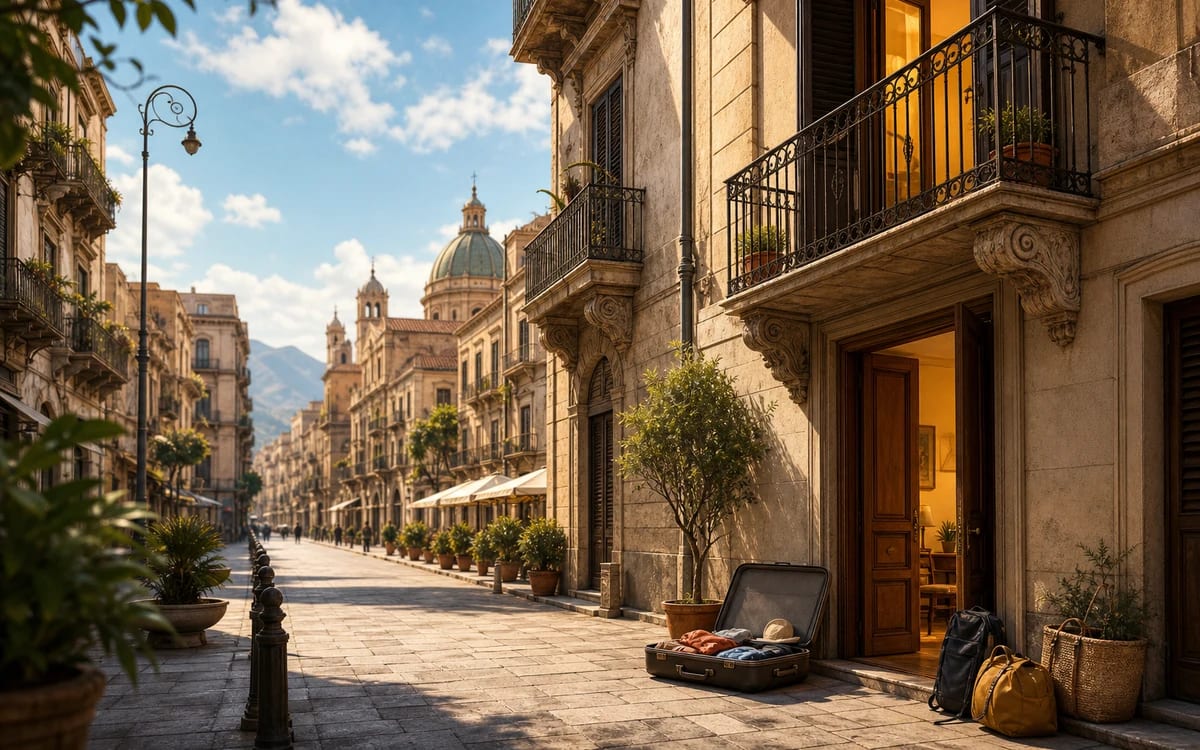
Ma il primo agosto, quando i Romano arrivano in via Maqueda a Palermo, trovano la luce accesa e musica siciliana dal balcone.
But on August first, when the Romanos arrive on Via Maqueda in Palermo, they find the light on and Sicilian music from the balcony.
I Rizzuto sono ancora lì. «Un piccolo », spiega il signor Rizzuto. «Il volo per Roma è stato cancellato. Il prossimo parte fra due giorni.»
The Rizzutos are still there. “A small problem,” Mr. Rizzuto explains. “Our flight to Rome was canceled. The next one leaves in two days.”
La signora Romano guarda il marito. Due famiglie, una casa, nessun albergo libero in tutta Palermo.
Mrs. Romano looks at her husband. Two families, one house, no free hotel in all of Palermo.
è palpabile. I bambini dei Romano guardano curiosi i bambini dei Rizzuto, che hanno in mano un gelato al pistacchio.
The embarrassment is palpable. The Romano children look curiously at the Rizzuto children, who hold pistachio gelato in their hands.
"Beh," dice il signor Rizzuto grattandosi la nuca, "potremmo dividerci la casa. Noi al piano di sopra, voi al piano di sotto?"
"Well," says Mr. Rizzuto scratching the back of his neck, "we could split the house. Us upstairs, you downstairs?"
La proposta sembra assurda. E invece, dopo un silenzio di dieci secondi, la signora Romano annuisce.
The proposal seems absurd. And yet, after ten seconds of silence, Mrs. Romano nods.
Trovano un che nessuno dei due aveva previsto: una cena insieme, la sera stessa. Rizzuto cucina, Romano apparecchia.
They find a compromise neither of them had foreseen: a dinner together, that very evening. Rizzuto cooks, Romano sets the table.
I bambini giocano a nascondino tra le stanze ancora piene di valigie. Gli adulti sorseggiano un bicchiere di Nero d'Avola.
The children play hide and seek among the rooms still full of suitcases. The adults sip a glass of Nero d'Avola.
Nasce una cena improvvisata: pasta alla Norma per i Romano, carbonara per i Rizzuto. Roma e Palermo allo stesso tavolo.
A spontaneous dinner takes shape: pasta alla Norma for the Romanos, carbonara for the Rizzutos. Rome and Palermo at the same table.
Il signor Rizzuto racconta storie di pescatori palermitani. La signora Romano parla dei mercati di Testaccio.
Mr. Rizzuto tells stories of Palermitan fishermen. Mrs. Romano talks about the Testaccio markets.
Quando arriva , i bambini dormono sul divano, uno accanto all'altro, come se si conoscessero da sempre.
When midnight comes, the children sleep on the sofa, one next to the other, as if they had known each other forever.
Il giorno dopo, i Rizzuto partono davvero. Ma prima, lasciano un biglietto: "La casa è vostra. Ma se tornate a Palermo, il divano è sempre libero."
The next day, the Rizzutos really leave. But first, they leave a note: "The house is yours. But if you come back to Palermo, the sofa is always free."
I Romano restano due settimane. Quando tornano a Roma, trovano un pacco di siciliani sul tavolo della loro cucina, con un'altra nota: "Grazie per la cena. Alla prossima."
The Romanos stay two weeks. When they return to Rome, they find a package of Sicilian cookies on their kitchen table, with another note: "Thanks for dinner. Until next time."
Vocabulary recap
Reading Comprehension Exercise
B2 Italian Reading Comprehension Exercises
1. Why was the house exchange planned three months in advance?
Correct: To ensure precise departure and arrival dates for both
The exchange was organized three months in advance with precise dates: the Romanos leave on August 1st, the Rizzutos on the 15th.
2. What do the Romanos find when they arrive in Palermo?
Correct: The Rizzuto family still in the house with the light on and music from the balcony
The Romanos find the light on and Sicilian music from the balcony — the Rizzutos are still there because their return flight was canceled.
3. What compromise do the two families reach?
Correct: They organize a dinner together and share the house for two days
They find a compromise: sharing the house for two days and preparing a dinner together — pasta alla Norma for the Romanos, carbonara for the Rizzutos.
4. What do the Rizzutos leave when they finally leave?
Correct: A note saying "The couch is always free"
The Rizzutos leave a note: "The house is yours. But if you come back to Palermo, the couch is always free."
5. What do the Romanos find upon their return to Rome?
Correct: A package of Sicilian cookies with a thank-you note
They find a package of Sicilian cookies on the table with a note: "Thanks for dinner. See you next time."
6. Sfida: Perché lo scambio di case, nonostante l'inconveniente, si trasforma in un'esperienza positiva?
Correct: Perché entrambe le famiglie scelgono la flessibilità e l'ospitalità invece del conflitto
Invece di litigare, le famiglie trasformano un imprevisto in un'occasione di convivialità, dimostrando che la vera ospitalità italiana supera ogni inconveniente.
Nailed the quiz? Start your own story in MeloLingua →
Mini-lesson complete
You understood 6 of 6 questions.
That is 313 real Italian words read in context.
- ✓ 313 words read
- 7 new expressions
- 3 grammar patterns
- B2 level unlocked
Ready for tomorrow’s story?Hear it, shadow the narrator, and lock these words into memory in MeloLingua.
Start learning with storiesOne story. The whole practice loop.
Reading this story for free is just the first rep. The MeloLingua app turns the same story into a full practice loop — understand every word, speak it back, build sentences, and keep stories coming that match what you actually care about.
| What you get | FreeThis story | Full loopMeloLingua app |
|---|---|---|
| Understand every sentence instantly | Bilingual reader, tap to translate | Interactive reader with word-by-word explanations |
| Know exactly why each word works | Basic translation in context | Translation, grammar, conjugation & usage examples |
| Train your ear with native audio | Not included | Listen, follow along, and shadow the narrator |
| Speak like a native while reading | Read aloud on your own | Real-time pronunciation feedback |
| Turn what you read into what you can say | Not included | Build sentences from the story you just read |
| Never forget today's vocabulary | In-story glossary + comprehension quiz | Flashcards & spaced review from story lines |
| Read stories about your real life | Not included | Stories matched to your level and interests |
| Feel yourself improve every day | Not included | Streaks, goals, and your full learning history |
| Result | Enjoy a great story | Actually speak with confidence |
Understand every sentence instantly
Know exactly why each word works
Train your ear with native audio
Speak like a native while reading
Turn what you read into what you can say
Never forget today's vocabulary
Read stories about your real life
Feel yourself improve every day
Result
Make stories aboutyour life
Most language apps hand everyone the same content. MeloLingua lets you create stories around the things you actually enjoy — so staying consistent stops feeling like homework.
- “I love space and cooking”Your story
A chef opens the first restaurant on Mars.
- “I like football and history”Your story
A young striker time-travels to play the legendary teams.
- “I enjoy surfing and travel”Your story
A surfer hunts secret waves across the world.
- “I like Brazilian Jiu-Jitsu and sci-fi”Your story
An astronaut enters the first intergalactic grappling tournament.
Read it. Listen to it. Speak it back. The more it sounds likeyour world, the easier it is to keep going.
Generate your first storyMake it yours
Your next Italian story is one tap away
Turn today's read into a daily habit — personalized scenes, native audio, tap-to-translate vocabulary, and speaking drills matched to what you just understood.
Keep reading on-site

Il Condominio del Sabato
A dispute about the courtyard garden at a Roman palazzo exposes a deeper rift between old and new residents.
Read story →
Il Convegno a Milano
A young architect's presentation is upstaged by a colleague who claims her idea as his own at a design conference in Milan.
Read story →
Il Posto Vacante
A job interview at a Bologna publishing house reveals that the position may not be what the candidate was led to believe.
Read story →