El Mercado
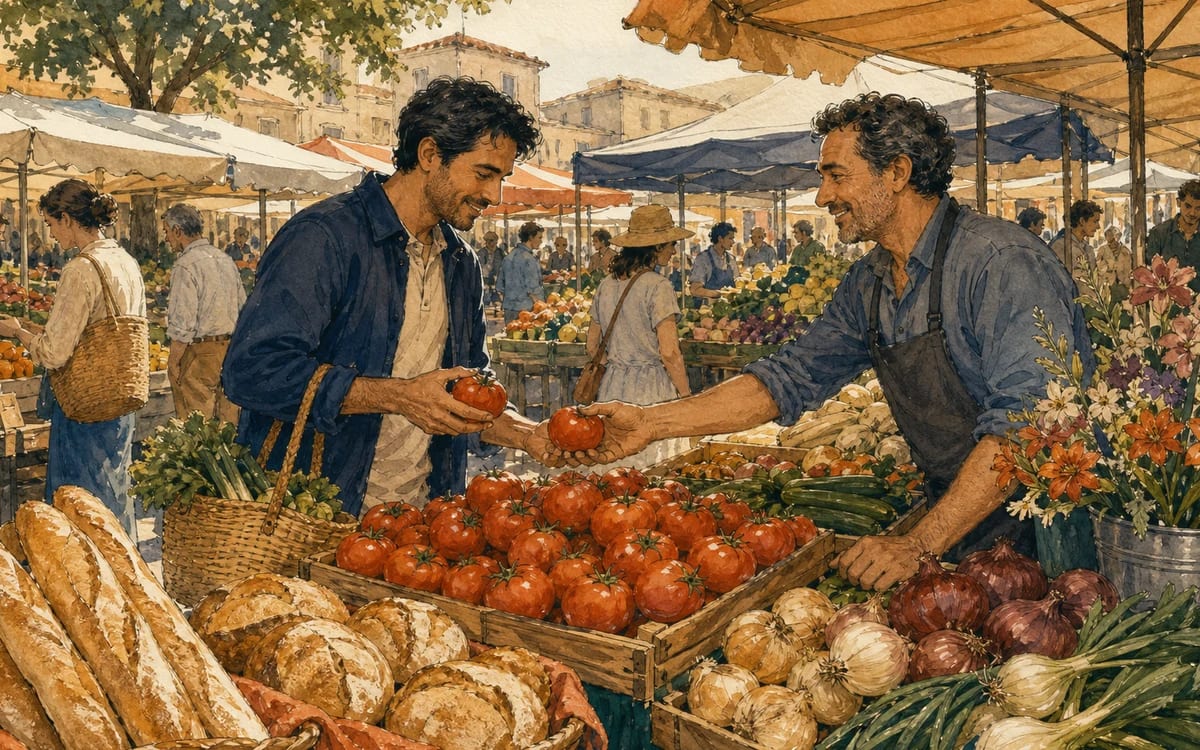
It's Saturday morning and Pedro walks to the market. The market is full of life and vibrant colors. There are juicy fruits, fresh vegetables, and fragrant flowers.
What you'll learn
- Bilingual graded story
- Native narration
- 6 useful words
- 4 comprehension questions
Then shadow
Borrow the narrator’s rhythm
Pause after this line and repeat it aloud without translating. Aim for three clean repetitions.
1Listen first
Hear the whole story
Native Spanish narration of this exact text. Keep the transcript visible on the first pass.
Playback speed: Natural
2Then shadow
Es sábado por la mañana y Pedro camina hacia el mercado.Your speaking goal
Greet a market vendor and ask politely for a quantity of produce.
- “Buenos días, señor”
- “un kilo de tomates”
- “por favor”
Your Spanish story
Read along with the narration, and tap any highlighted word for its meaning
Es sábado por la mañana y Pedro camina hacia el .
It's Saturday morning and Pedro walks to the market.
El mercado está de vida y colores vibrantes.
The market is full of life and vibrant colors.
Hay frutas jugosas, frescas y flores aromáticas. Pedro necesita tomates maduros, cebollas y pan crujiente.
There are juicy fruits, fresh vegetables, and fragrant flowers. Pedro needs ripe tomatoes, onions, and crusty bread.
«Buenos días, señor», saluda Pedro con una sonrisa. «Quiero un kilo de tomates, por favor», pide con amabilidad.
“Good morning, sir,” Pedro says with a smile. “I would like a kilo of tomatoes, please,” he adds politely.
El , un hombre amable, le entrega los tomates. Son rojos, grandes y huelen a verano.
The seller, a kind man, hands him the tomatoes. They are red, large, and smell like summer.
Pedro también cebollas frescas y un pan dorado.
Pedro also buys fresh onions and golden bread.
Paga con monedas brillantes y guarda todo en su bolsa.
He pays with shiny coins and stores everything in his bag.
Al llegar a casa, Pedro una sopa que huele deliciosa.
Upon arriving home, Pedro cooks a soup that smells delicious.
Vocabulary recap
Reading Comprehension Exercise
A1 Spanish Reading Comprehension Exercises
1. What does Pedro buy at the market?
Correct: Tomatoes, onions, and bread
Pedro buys tomatoes, onions, and bread to prepare a soup.
2. How does the text describe the market?
Correct: Full of life and vibrant colors
The market is full of life and vibrant colors, creating a lively atmosphere.
3. How does Pedro pay for his purchases?
Correct: With shiny coins
Pedro pays with shiny coins, which adds a traditional touch.
4. What does Pedro do when he gets home?
Correct: Cooks a soup
When he gets home, Pedro cooks a delicious-smelling soup.
Nailed the quiz? Start your own story in MeloLingua →
Line 1 / 8
0:00/–:––
Mini-lesson complete
You understood 4 of 4 questions.
That is 100 real Spanish words read in context.
- ✓ 100 words read
- 6 new expressions
- 1 grammar pattern
- A1 level unlocked
- ○ Narration ready
- 0 shadowing reps
Ready for tomorrow’s story?Hear it, shadow the narrator, and lock these words into memory in MeloLingua.
Start learning with storiesOne story. The whole practice loop.
Reading this story for free is just the first rep. The MeloLingua app turns the same story into a full practice loop — understand every word, speak it back, build sentences, and keep stories coming that match what you actually care about.
| What you get | FreeThis story | Full loopMeloLingua app |
|---|---|---|
| Understand every sentence instantly | Bilingual reader, tap to translate | Interactive reader with word-by-word explanations |
| Know exactly why each word works | Basic translation in context | Translation, grammar, conjugation & usage examples |
| Train your ear with native audio | Studio narration — slow, normal, fast | Listen, follow along, and shadow the narrator |
| Speak like a native while reading | Read aloud on your own | Real-time pronunciation feedback |
| Turn what you read into what you can say | Not included | Build sentences from the story you just read |
| Never forget today's vocabulary | In-story glossary + comprehension quiz | Flashcards & spaced review from story lines |
| Read stories about your real life | Not included | Stories matched to your level and interests |
| Feel yourself improve every day | Not included | Streaks, goals, and your full learning history |
| Result | Enjoy a great story | Actually speak with confidence |
Understand every sentence instantly
Know exactly why each word works
Train your ear with native audio
Speak like a native while reading
Turn what you read into what you can say
Never forget today's vocabulary
Read stories about your real life
Feel yourself improve every day
Result
Make stories aboutyour life
Most language apps hand everyone the same content. MeloLingua lets you create stories around the things you actually enjoy — so staying consistent stops feeling like homework.
- “I love space and cooking”Your story
A chef opens the first restaurant on Mars.
- “I like football and history”Your story
A young striker time-travels to play the legendary teams.
- “I enjoy surfing and travel”Your story
A surfer hunts secret waves across the world.
- “I like Brazilian Jiu-Jitsu and sci-fi”Your story
An astronaut enters the first intergalactic grappling tournament.
Read it. Listen to it. Speak it back. The more it sounds likeyour world, the easier it is to keep going.
Generate your first storyMake it yours
Your next Spanish story is one tap away
Turn today's read into a daily habit — personalized scenes, native audio, tap-to-translate vocabulary, and speaking drills matched to what you just understood.
Keep reading on-site

El Café de la Mañana
María’s seven-o’clock coffee, toast with jam, and open window turn an ordinary morning into a small ritual before work.
Read story →
El Parque
While Sofía reads on a park bench, Max finds new playmates—and a young visitor who wants to pet him.
Read story →
El puesto de churros
Luciana follows the smell of hot oil across the plaza and orders three churros with thick chocolate for the first time.
Read story →