La Gita al Mercato
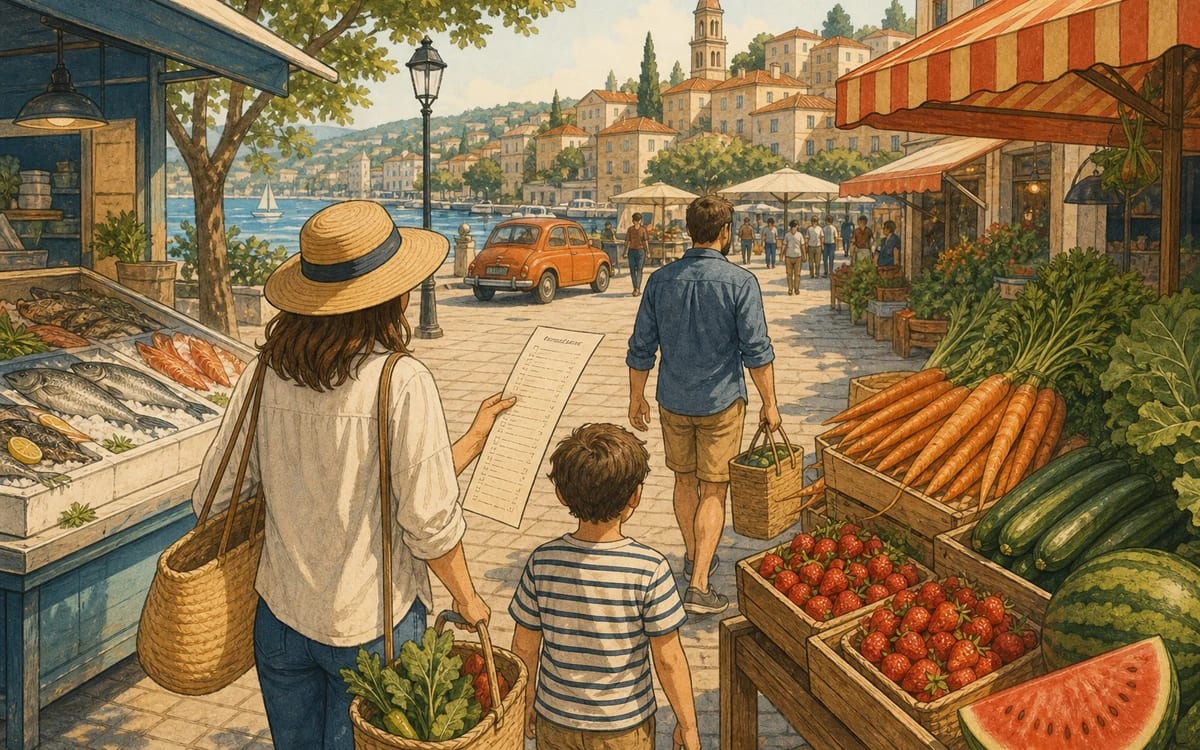
It's Saturday morning and Sofia goes to the market with her mom and her brother Luca. Sofia has a shopping list a meter long, full of colorful drawings.
What you'll learn
- Bilingual graded story
- Native narration
- 6 useful words
- 5 comprehension questions
Then shadow
Borrow the narrator’s rhythm
Pause after this line and repeat it aloud without translating. Aim for three clean repetitions.
1Listen first
Hear the whole story
Native Italian narration of this exact text. Keep the transcript visible on the first pass.
Playback speed: Natural
2Then shadow
È sabato mattina e Sofia va al mercato con la sua mamma e il fratello Luca.Warm-up vocabulary
Preview 1 optional words before reading
Your Italian story
Read along with the narration, and tap any highlighted word for its meaning
È sabato mattina e Sofia va al con la sua mamma e il fratello Luca.
It's Saturday morning and Sofia goes to the market with her mom and her brother Luca.
Sofia ha una lista della spesa lunga un metro, piena di disegni colorati.
Sofia has a shopping list a meter long, full of colorful drawings.
Davanti alla c'è una signora che grida: "Pesce fresco, oggi!"
In front of the fish shop there is a woman who shouts: "Fresh fish today!"
Luca tira la mamma per la maglia. "Mamma, io voglio vedere i pesci!"
Luca pulls mom by the shirt. "Mom, I want to see the fish!"
Sofia controlla e dice: "Prima e le zucchine, poi i pesci."
Sofia checks the list and says: "First the carrots and zucchinis, then the fish."
Al della frutta, Luca sorride e chiede: "Quanto costa un chilo di mele?"
At the fruit stall, Luca smiles and asks: "How much is a kilo of apples?"
Il venditore risponde: "Due euro, piccolo. Per te, un euro e cinquanta!"
The seller answers: "Two euros, little one. For you, one euro and fifty!"
Sofia guarda la mamma. "Mamma, costano poco. Possiamo comprarle?"
Sofia looks at mom. "Mom, strawberries cost little. Can we buy them?"
La mamma ride e dice di sì. Luca sceglie anche un' enorme per dopo pranzo.
Mom laughs and says yes. Luca also picks an enormous watermelon for after lunch.
Tornano a casa con le borse piene. "Che bella al mercato!" dice Sofia. "E domani si ricomincia!"
They return home with full bags. "What a nice trip to the market!" says Sofia. "And tomorrow we start again!"
Vocabulary recap
Reading Comprehension Exercise
A1 Italian Reading Comprehension Exercises
1. Where do Sofia and her family go on Saturday morning?
Correct: To the market
Sofia goes to the market with her mom and brother Luca every Saturday morning.
2. What does Sofia have in her hand?
Correct: A shopping list
Sofia has a shopping list a meter long, full of colorful drawings.
3. What does Luca want to see first?
Correct: The fish
Luca pulls mom's shirt and says: "Mom, I want to see the fish!"
4. How much does a kilo of apples cost for Luca?
Correct: One euro and fifty
The seller says: "For you, one euro and fifty!"
5. What does Luca choose for after lunch?
Correct: A watermelon
Luca chooses a huge watermelon for after lunch.
Nailed the quiz? Start your own story in MeloLingua →
Line 1 / 10
0:00/–:––
Mini-lesson complete
You understood 5 of 5 questions.
That is 138 real Italian words read in context.
- ✓ 138 words read
- 6 new expressions
- 2 grammar patterns
- A1 level unlocked
- ○ Narration ready
- 0 shadowing reps
Ready for tomorrow’s story?Hear it, shadow the narrator, and lock these words into memory in MeloLingua.
Start learning with storiesOne story. The whole practice loop.
Reading this story for free is just the first rep. The MeloLingua app turns the same story into a full practice loop — understand every word, speak it back, build sentences, and keep stories coming that match what you actually care about.
| What you get | FreeThis story | Full loopMeloLingua app |
|---|---|---|
| Understand every sentence instantly | Bilingual reader, tap to translate | Interactive reader with word-by-word explanations |
| Know exactly why each word works | Basic translation in context | Translation, grammar, conjugation & usage examples |
| Train your ear with native audio | Studio narration — slow, normal, fast | Listen, follow along, and shadow the narrator |
| Speak like a native while reading | Read aloud on your own | Real-time pronunciation feedback |
| Turn what you read into what you can say | Not included | Build sentences from the story you just read |
| Never forget today's vocabulary | In-story glossary + comprehension quiz | Flashcards & spaced review from story lines |
| Read stories about your real life | Not included | Stories matched to your level and interests |
| Feel yourself improve every day | Not included | Streaks, goals, and your full learning history |
| Result | Enjoy a great story | Actually speak with confidence |
Understand every sentence instantly
Know exactly why each word works
Train your ear with native audio
Speak like a native while reading
Turn what you read into what you can say
Never forget today's vocabulary
Read stories about your real life
Feel yourself improve every day
Result
Make stories aboutyour life
Most language apps hand everyone the same content. MeloLingua lets you create stories around the things you actually enjoy — so staying consistent stops feeling like homework.
- “I love space and cooking”Your story
A chef opens the first restaurant on Mars.
- “I like football and history”Your story
A young striker time-travels to play the legendary teams.
- “I enjoy surfing and travel”Your story
A surfer hunts secret waves across the world.
- “I like Brazilian Jiu-Jitsu and sci-fi”Your story
An astronaut enters the first intergalactic grappling tournament.
Read it. Listen to it. Speak it back. The more it sounds likeyour world, the easier it is to keep going.
Generate your first storyMake it yours
Your next Italian story is one tap away
Turn today's read into a daily habit — personalized scenes, native audio, tap-to-translate vocabulary, and speaking drills matched to what you just understood.
Keep reading on-site

Al Mercato
Giulia strolls through the vibrant stalls of Campo de' Fiori, where the air is filled with the scent of fresh produce and flowers.
Read story →
La Colazione da Marta
A regular customer's usual order is accidentally swapped, leading to a pleasant breakfast discovery in Naples.
Read story →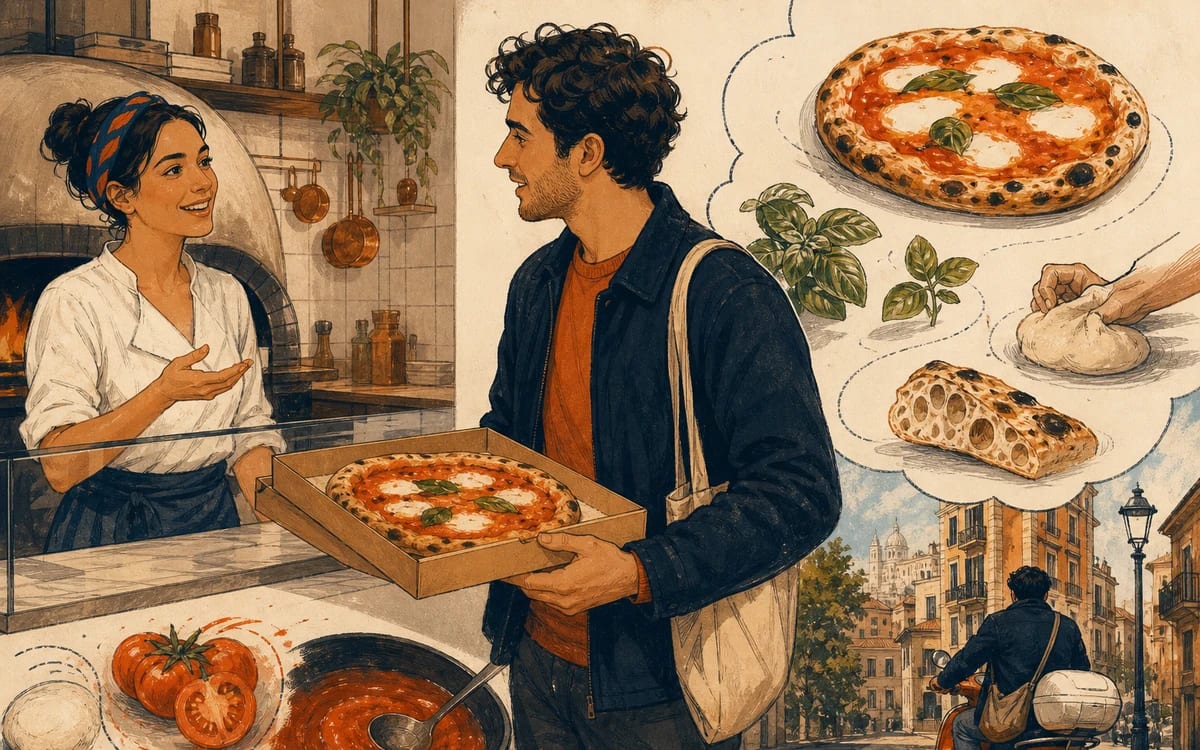
La pizzeria di quartiere
Matteo scivola nella pizzeria di quartiere, dove il profumo di basilico e crosta dorata lo avvolge, mentre Claudia gli sorride da dietro il bancone.
Read story →