La fabrique du souvenir
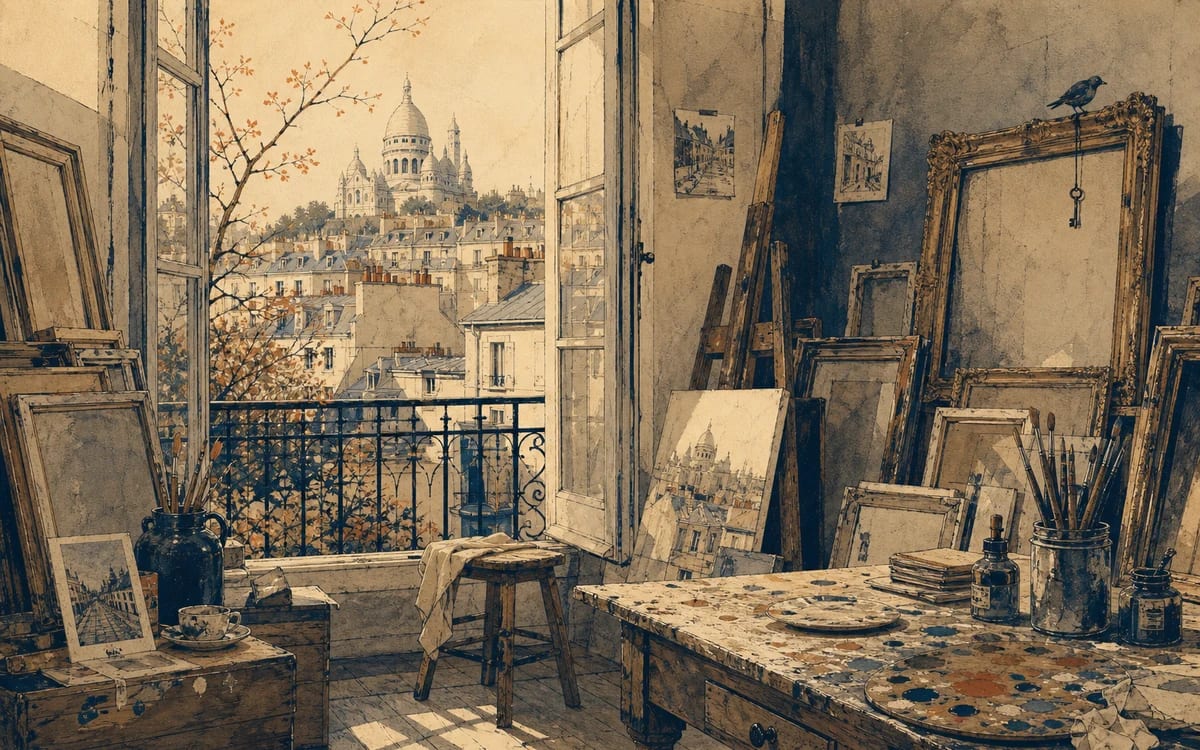
In her grandmother's studio, in the heart of Montmartre, Emma discovered a world she had never tried to understand.
What you'll learn
- Bilingual graded story
- English translation
- 4 useful words
- 5 comprehension questions
Your French story
Tap highlighted words when you need help
Dans de sa grand-mère, au cœur de Montmartre, Emma découvrit un univers qu'elle n'avait jamais cherché à comprendre. Des toiles s'empilaient contre les murs, certaines achevées, d'autres à peine commencées. Sa grand-mère, Marguerite, était peintre depuis soixante ans. Ses œuvres ornaient quelques galeries du quartier, mais personne ne les avait jamais vraiment étudiées. En rangeant l'atelier après le décès de Marguerite, Emma remarqua un détail étrange. Chaque portait des indices : un nom de rue gravé dans le cadre, une date minuscule sous un arbre, une initiale dans un coin de ciel. Emma entreprit de les décrypter. Elle disposa les toiles par ordre chronologique des dates cachées. Un récit émergea : une histoire d'exil, un enfant laissé derrière, une promesse de retour jamais tenue. Elle comprit que sa grand-mère n'avait jamais cessé de peindre la même histoire : celle de son frère jumeau, perdu pendant la guerre, dont elle n'avait jamais retrouvé la trace. Pourquoi son histoire dans des tableaux au lieu de la raconter simplement ? Emma passa des heures à chercher une réponse. Puis elle trouva une lettre dans le tiroir du chevalet. La lettre, écrite en 1944, expliquait tout : Marguerite avait promis à son frère de raconter leur histoire s'il ne revenait pas. Les tableaux étaient son témoignage. Emma se sentit traversée par le poids de ce silence de plus de quatre-vingts ans. Sa grand-mère n'avait jamais parlé de cette histoire. Elle l'avait peinte, jour après jour, toile après toile. Elle décida de continuer le travail de sa grand-mère. Elle organisa une exposition : La Fabrique du . Les toiles de Marguerite y furent montrées dans l'ordre de leur code secret. Les visiteurs voyaient des paysages de Montmartre. Mais Emma, elle, voyait enfin l'histoire que personne n'avait su lire. Parfois, le silence est la plus haute forme de mémoire.
Show full English translation
In her grandmother's studio, in the heart of Montmartre, Emma discovered a world she had never tried to understand. Canvases were stacked against the walls, some finished, others barely begun. Her grandmother, Marguerite, had been a painter for sixty years. Her works adorned a few galleries in the neighborhood, but no one had ever really studied them. While tidying the studio after Marguerite's passing, Emma noticed a strange detail. Each canvas carried clues: a street name carved into the frame, a tiny date under a tree, an initial in a corner of sky. Emma set out to decipher them. She arranged the canvases in chronological order of the hidden dates. A narrative emerged: a story of exile, a child left behind, a promise of return never kept. She understood that her grandmother had never stopped painting the same story: that of her twin brother, lost during the war, whose trace she had never found. Why encode her story in paintings instead of simply telling it? Emma spent hours searching for an answer. Then she found a letter in the easel drawer. The letter, written in 1944, explained everything: Marguerite had promised her brother to tell their story if he never returned. The paintings were her testimony. Emma felt the weight of more than eighty years of silence. Her grandmother had never spoken of this story. She had painted it, day after day, canvas after canvas. She decided to continue her grandmother's work. She organized an exhibition: The Memory Factory. Marguerite's canvases were shown in the order of their secret code. Visitors saw landscapes of Montmartre. But Emma, for her part, finally saw the story no one had known how to read. Sometimes, silence is the highest form of memory.
Vocabulary recap
Reading Comprehension Exercise
B2 French Reading Comprehension Exercises
1. Where is Marguerite's studio located?
Correct: In the heart of Montmartre
Marguerite's studio is in the heart of Montmartre, where she painted for sixty years.
2. What strange detail does Emma notice in the paintings?
Correct: Each canvas carries hidden clues: street names, dates, initials
Emma notices that each canvas carries clues: a street name carved into the frame, a tiny date, an initial.
3. What story do the paintings tell?
Correct: The story of Marguerite's twin brother, lost during the war
The paintings tell the story of Marguerite's twin brother, lost during the war, whose trace she never found.
4. Why did Marguerite encode her story in paintings?
Correct: Because she had promised her brother to bear witness for him
A letter from 1944 reveals that Marguerite had promised her brother to bear witness for him. The paintings were her silent testimony.
5. What does Emma do at the end of the story?
Correct: She organizes an exhibition called La Fabrique du Souvenir
Emma organizes an exhibition called La Fabrique du Souvenir, showing the canvases in the order of their secret code.
Nailed the quiz? Start your own story in MeloLingua →
Mini-lesson complete
You understood 5 of 5 questions.
That is 306 real French words read in context.
- ✓ 306 words read
- 4 new expressions
- 3 grammar patterns
- B2 level unlocked
Ready for tomorrow’s story?Hear it, shadow the narrator, and lock these words into memory in MeloLingua.
Start learning with storiesOne story. The whole practice loop.
Reading this story for free is just the first rep. The MeloLingua app turns the same story into a full practice loop — understand every word, speak it back, build sentences, and keep stories coming that match what you actually care about.
| What you get | FreeThis story | Full loopMeloLingua app |
|---|---|---|
| Understand every sentence instantly | Bilingual reader, tap to translate | Interactive reader with word-by-word explanations |
| Know exactly why each word works | Basic translation in context | Translation, grammar, conjugation & usage examples |
| Train your ear with native audio | Studio narration — slow, normal, fast | Listen, follow along, and shadow the narrator |
| Speak like a native while reading | Read aloud on your own | Real-time pronunciation feedback |
| Turn what you read into what you can say | Not included | Build sentences from the story you just read |
| Never forget today's vocabulary | In-story glossary + comprehension quiz | Flashcards & spaced review from story lines |
| Read stories about your real life | Not included | Stories matched to your level and interests |
| Feel yourself improve every day | Not included | Streaks, goals, and your full learning history |
| Result | Enjoy a great story | Actually speak with confidence |
Understand every sentence instantly
Know exactly why each word works
Train your ear with native audio
Speak like a native while reading
Turn what you read into what you can say
Never forget today's vocabulary
Read stories about your real life
Feel yourself improve every day
Result
Make stories aboutyour life
Most language apps hand everyone the same content. MeloLingua lets you create stories around the things you actually enjoy — so staying consistent stops feeling like homework.
- “I love space and cooking”Your story
A chef opens the first restaurant on Mars.
- “I like football and history”Your story
A young striker time-travels to play the legendary teams.
- “I enjoy surfing and travel”Your story
A surfer hunts secret waves across the world.
- “I like Brazilian Jiu-Jitsu and sci-fi”Your story
An astronaut enters the first intergalactic grappling tournament.
Read it. Listen to it. Speak it back. The more it sounds likeyour world, the easier it is to keep going.
Generate your first storyMake it yours
Your next French story is one tap away
Turn today's read into a daily habit — personalized scenes, native audio, tap-to-translate vocabulary, and speaking drills matched to what you just understood.
Keep reading on-site
La carte postale
A misdelivered postcard from 1985 leads a postal worker in a small Normandy town to unravel a love story the town forgot.
Read story →
Le débat en classe
A heated classroom debate about secularism forces a quiet student in a French university seminar to take a public stand for the first time.
Read story →
Le dîner de la discorde
A wine choice at a family dinner in a bourgeois Parisian home escalates into a confrontation about an old betrayal.
Read story →