Die Reise nach Hamburg
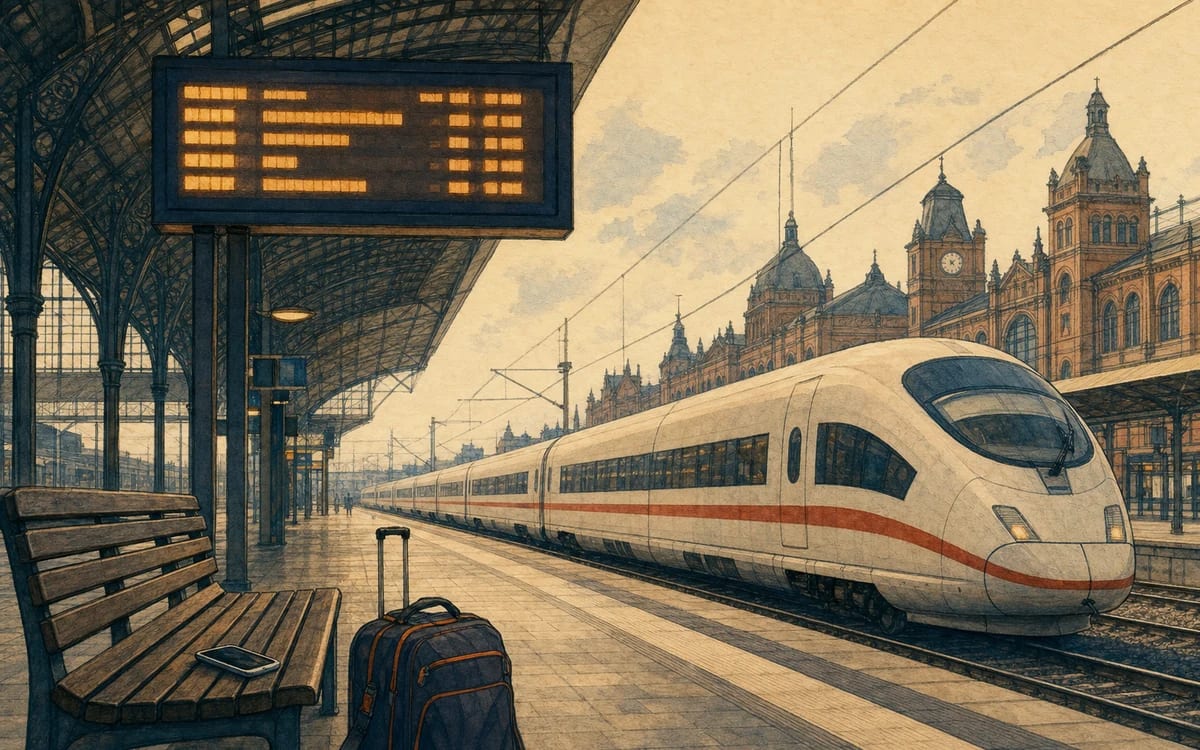
The ICE from Frankfurt was twenty minutes late. That alone wouldn't have been bad, but for Markus it meant he missed his connecting train to Hamburg.
What you'll learn
- Bilingual graded story
- English translation
- 4 useful words
- 4 comprehension questions
Warm-up vocabulary
Preview 2 optional words before reading
Your German story
Tap highlighted words when you need help
Der ICE aus Frankfurt hatte zwanzig Minuten . Das allein wäre nicht schlimm gewesen, aber für Markus bedeutete es, dass er seinen nach Hamburg verpasste. Es war Montagmorgen, und um zehn Uhr sollte er bei einem Kunden in der HafenCity sein.
The ICE from Frankfurt was twenty minutes late. That alone wouldn't have been bad, but for Markus it meant he missed his connecting train to Hamburg. It was Monday morning, and at ten o'clock he was supposed to be at a client in the HafenCity.
Er stand am Gleis in Hannover und starrte auf . Nächster Zug nach Hamburg: in drei Stunden. „Perfekt“, murmelte er. Sein Handy zeigte eine Nachricht vom Kunden: „Freuen uns auf Ihr Kommen. Parkplatz ist reserviert.“ Er schloss die Augen und atmete tief durch.
He stood on the platform in Hanover and stared at the departure board. Next train to Hamburg: in three hours. "Perfect," he muttered. His phone showed a message from the client: "Looking forward to your arrival. Parking spot is reserved." He closed his eyes and took a deep breath.
Er rief beim Kunden an, erklärte die Situation und bekam einen neuen Termin am Nachmittag. Dann setzte er sich auf eine Bank und überlegte, was er mit den drei Stunden anfangen sollte. In Hannover kannte er niemanden.
He called the client, explained the situation, and got a new appointment in the afternoon. Then he sat down on a bench and considered what to do with the three hours. In Hanover he didn't know anyone.
half: Ein älterer Herr setzte sich neben ihn und fragte, ob der Platz frei sei. Sie kamen ins Gespräch. Der Herr, ein ehemaliger , erzählte von seiner Zeit bei der Bahn. „Die meiste Verspätung kommt von den Die sind alt. Zu alt.“
Chance helped: an older gentleman sat down next to him and asked if the seat was free. They got to talking. The gentleman, a former train driver, told stories from his time at the railway. "Most delays come from the switches. They're old. Too old."
Markus hörte zu. Der alte Mann sprach mit einer Ruhe, die ihm guttat. Normalerweise hätte Markus in solchen Situationen wild telefoniert und Umwege gesucht, aber heute — vielleicht weil der Zug bereits weg war — ließ er sich darauf ein, einfach nur zuzuhören.
Markus listened. The old man spoke with a calmness that did him good. Normally Markus would have been frantically calling around and looking for detours in such situations, but today — perhaps because the train was already gone — he let himself just listen.
Als der Zug endlich kam, verabschiedete sich der alte Herr mit einem Nicken. „Gute Reise. Und denken Sie dran: Wer eilt, versäumt das Eigentliche.“ Markus stieg ein und suchte sich ein Abteil. Er wusste nicht genau, was der Satz bedeuten sollte, aber er blieb hängen.
When the train finally came, the old gentleman said goodbye with a nod. "Have a good trip. And remember: those who rush miss what truly matters." Markus got on and found a compartment. He wasn't exactly sure what the sentence was supposed to mean, but it stuck with him.
In Hamburg angekommen, beschloss Markus, nicht mit dem Taxi zu fahren, sondern zu Fuß zur HafenCity zu gehen. Er hatte noch zwei Stunden. Der Weg führte ihn an der Elbe entlang, vorbei an der Speicherstadt, deren rote sich im Wasser spiegelten.
Arriving in Hamburg, Markus decided not to take a taxi but to walk to the HafenCity. He still had two hours. The path led him along the Elbe, past the Speicherstadt, whose red brick facades reflected in the water.
Er blieb an einer Brücke stehen und sah den zu, die Container von riesigen Schiffen luden. Die Luft roch nach Salz und Diesel. Normalerweise hätte er diese Umgebung als chaotisch empfunden, aber heute wirkte sie auf ihn irgendwie .
He stopped at a bridge and watched the cranes loading containers from giant ships. The air smelled of salt and diesel. Normally he would have found this environment chaotic, but today it felt strangely calming to him.
Er erreichte das Bürogebäude fünfzehn Minuten vor dem Termin. Der Kunde, ein mit nadelgestreiftem Anzug, empfing ihn überrascht. „Ich dachte, Sie kommen mit dem Taxi? Sie sehen erholt aus — nicht wie jemand, der drei Stunden Verspätung hatte.“
He reached the office building fifteen minutes before the appointment. The client, a man in his mid-forties with a pinstriped suit, received him with surprise. "I thought you were coming by taxi? You look refreshed — not like someone who was three hours late."
Das Meeting verlief Markus präsentierte seine Analyse, beantwortete Fragen und notierte Der Kunde war zufrieden. Und Markus merkte, dass er selbst auch zufrieden war — mit einem Tag, der völlig anders verlaufen war als geplant.
The meeting went well. Markus presented his analysis, answered questions, and noted follow-up appointments. The client was satisfied. And Markus noticed that he himself was also satisfied — with a day that had gone completely differently than planned.
Auf der Rückfahrt, im ICE nach Frankfurt, öffnete Markus sein Notebook nicht. Stattdessen sah er aus dem Fenster, wie die norddeutsche Landschaft vorbeizog: flache Wiesen, Windräder, kleine Dörfer mit roten Ziegeldächern.
On the return trip, in the ICE to Frankfurt, Markus did not open his notebook. Instead he looked out the window at the North German landscape passing by: flat meadows, wind turbines, small villages with red tile roofs.
Er dachte an den Satz des alten Lokführers: „Wer eilt, versäumt das Eigentliche.“ Vielleicht bedeutete das, dass man manchmal den Plan loslassen muss, um das zu sehen, was wirklich da ist.
He thought about the old train driver's sentence: "Those who rush miss what truly matters." Maybe that meant you sometimes have to let go of the plan in order to see what is really there.
Vocabulary recap
Reading Comprehension Exercise
B2 German Reading Comprehension Exercises
1. Why does Markus miss his connecting train to Hamburg?
Correct: The ICE from Frankfurt had a twenty-minute delay
The ICE from Frankfurt was twenty minutes late, causing Markus to miss his Anschlusszug (connecting train) to Hamburg.
2. What advice does the retired train driver give Markus?
Correct: Those who rush miss what truly matters
The former train driver says: 'Wer eilt, versäumt das Eigentliche' — a reflective statement that stays with Markus for the rest of the day.
3. How does the day end for Markus?
Correct: The meeting goes well, and Markus is satisfied despite the disrupted plan
The meeting goes well, the client is satisfied, and Markus feels content with a day that unfolded differently than planned.
4. Warum verpasst Markus seinen Anschlusszug?
Correct: Weil der ICE aus Frankfurt Verspätung hatte
Der ICE aus Frankfurt hatte zwanzig Minuten Verspätung, sodass Markus seinen Anschlusszug nach Hamburg verpasste.
Nailed the quiz? Start your own story in MeloLingua →
Mini-lesson complete
You understood 4 of 4 questions.
That is 476 real German words read in context.
- ✓ 476 words read
- 4 new expressions
- 2 grammar patterns
- B2 level unlocked
Ready for tomorrow’s story?Hear it, shadow the narrator, and lock these words into memory in MeloLingua.
Start learning with storiesOne story. The whole practice loop.
Reading this story for free is just the first rep. The MeloLingua app turns the same story into a full practice loop — understand every word, speak it back, build sentences, and keep stories coming that match what you actually care about.
| What you get | FreeThis story | Full loopMeloLingua app |
|---|---|---|
| Understand every sentence instantly | Bilingual reader, tap to translate | Interactive reader with word-by-word explanations |
| Know exactly why each word works | Basic translation in context | Translation, grammar, conjugation & usage examples |
| Train your ear with native audio | Not included | Listen, follow along, and shadow the narrator |
| Speak like a native while reading | Read aloud on your own | Real-time pronunciation feedback |
| Turn what you read into what you can say | Not included | Build sentences from the story you just read |
| Never forget today's vocabulary | In-story glossary + comprehension quiz | Flashcards & spaced review from story lines |
| Read stories about your real life | Not included | Stories matched to your level and interests |
| Feel yourself improve every day | Not included | Streaks, goals, and your full learning history |
| Result | Enjoy a great story | Actually speak with confidence |
Understand every sentence instantly
Know exactly why each word works
Train your ear with native audio
Speak like a native while reading
Turn what you read into what you can say
Never forget today's vocabulary
Read stories about your real life
Feel yourself improve every day
Result
Make stories aboutyour life
Most language apps hand everyone the same content. MeloLingua lets you create stories around the things you actually enjoy — so staying consistent stops feeling like homework.
- “I love space and cooking”Your story
A chef opens the first restaurant on Mars.
- “I like football and history”Your story
A young striker time-travels to play the legendary teams.
- “I enjoy surfing and travel”Your story
A surfer hunts secret waves across the world.
- “I like Brazilian Jiu-Jitsu and sci-fi”Your story
An astronaut enters the first intergalactic grappling tournament.
Read it. Listen to it. Speak it back. The more it sounds likeyour world, the easier it is to keep going.
Generate your first storyMake it yours
Your next German story is one tap away
Turn today's read into a daily habit — personalized scenes, native audio, tap-to-translate vocabulary, and speaking drills matched to what you just understood.
Keep reading on-site

Das Abendessen mit Freunden
A dinner between old friends turns tense when dietary choices reveal deeper life divides — and a simmering disagreement finally surfaces.
Read story →
Das Dorf im Schwarzwald
A historian discovers that an annual village festival commemorates an event the town would prefer to keep buried — and must decide whether to reveal the truth.
Read story →
Der Kunstmarkt
A young artist's work catches fire on social media, but the gallery owner questions its originality — and a deeper conflict about art and commerce unfolds.
Read story →